

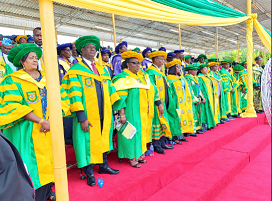
TINUBU’S ASSENT USHERS YABATECH INTO UNIVERSITY ERA, RECTOR UNVEILS 10-POINT DEVELOPMENT AGENDA Abdul seeks Federal Government’s support for infrastructure, research, technology and staff development as institution prepares for transformation
Yaba College of Technology (YABATECH) has begun a new chapter in its institutional history following President Bola Ahmed Tinubu’s assent to the legislation establishing the Federal University of Technology and Vocational Studies, Yaba, Lagos, with the Rector, Dr. Engr. Ibraheem Adedotun Abdul, unveiling a 10-point development agenda to guide its transition into a specialised university.
Abdul, who announced the development at the institution’s 38th Convocation Ceremony on Thursday, November 19, 2026, described the presidential assent as the fulfilment of the College’s 20-year aspiration and a major recognition of its nearly eight decades of contributions to technological and vocational education in Nigeria.
He said the transition had opened a new chapter of greater possibilities, wider responsibilities and higher expectations for the institution, stressing that the transformation must be anchored on academic excellence, technological advancement, institutional discipline and collective responsibility.
According to him, the emergence of the Federal University of Technology and Vocational Studies represents an important development in Nigeria’s higher education landscape and an affirmation of the growing importance of technical competence, vocational proficiency, innovation and entrepreneurship to national development.
The Rector, however, cautioned that university status alone would not automatically translate into academic excellence, technological innovation or global competitiveness.
“The true measure of our transformation will therefore not be the designation we carry, but the quality of our graduates, the relevance of our research, the strength of our industry partnerships and the value we contribute to society,” he said.
Abdul outlined a 10-point strategic framework for the emerging university, including the development of a distinctive institutional identity, strengthening academic excellence and quality assurance, advancing research and innovation, preserving technical and vocational education, promoting entrepreneurship, investing in human capital, modernising infrastructure, deepening industry partnerships, accelerating digital transformation and pursuing global competitiveness.
He said the institution would be positioned at the intersection of knowledge, skills, innovation and industry, with practical learning, experimentation, technological application and problem-solving forming the core of its academic philosophy.
According to him, the new university would prioritise laboratories, workshops, studios, innovation centres and industrial facilities, while strengthening the relationship between classroom learning and workplace experience through structured industrial exposure and professional collaboration.
He added that academic programmes would be continuously reviewed to respond to emerging technologies, industry demands and changing societal needs, noting that the future of work required graduates who could adapt to new occupations and evolving economic opportunities.
The Rector said the institution aspired to produce graduates who were knowledgeable, technically competent, innovative, entrepreneurial and ethically responsible. “Our guiding philosophy should be clear: a university where knowledge meets skills, innovation meets industry, and education creates value,” he declared.
Abdul appealed to the Federal Government for sustained investment in academic infrastructure, research facilities, technological equipment, staff development and institutional systems to ensure the successful operationalisation of the university.
He said investment in technological and vocational education should be regarded as an investment in national productivity, economic resilience and future prosperity, adding that Nigeria’s industrial and economic aspirations depended substantially on the development of a highly skilled workforce.
The Rector also highlighted achievements recorded by his administration in infrastructure, academic expansion, research, entrepreneurship, international collaboration, environmental sustainability and human capital development.
The convocation also witnessed the conferment of the College’s prestigious Fellowship on the Minister of Education, Dr. Maruf Tunji Alausa; the Minister of Finance and Coordinating Minister of the Economy, Prof. Taiwo Oyedele; and an alumna, Mrs. Itunu Omotayo, in recognition of their contributions to education, public administration, economic development and society.
The Rector said YABATECH, established in 1947, remained committed to preserving its heritage while advancing technological education to meet Nigeria’s changing developmental needs.
He urged stakeholders to view the transition not as a single administrative event but as a continuous process of institution-building requiring sustainable financing, effective governance, appropriate approvals and collective commitment.
“Yaba College of Technology.
Tweet this news
Yabatech News
-
Nov 26, 2026 04:28 pm
OYEDELE UNVEILS AWARD FOR YABATECH BEST GRADUANDS
-

Nov 26, 2026 04:26 pm
YABATECH'S TRANSFORMATION: OBASA, COUNCIL, PARTNERS CELEBRATE INSTITUTIONAL MILESTONE Rector pledges stronger partnerships, staff and student empowerment as College honours contributors at 38th Convocation Dinner
-
Nov 26, 2026 04:23 pm
TINUBU’S ASSENT USHERS YABATECH INTO UNIVERSITY ERA, RECTOR UNVEILS 10-POINT DEVELOPMENT AGENDA Abdul seeks Federal Government’s support for infrastructure, research, technology and staff development as institution prepares for transformation
-

Nov 26, 2026 04:21 pm
HAMZAT ADVOCATES STRONGER COLLABORATION BETWEEN EDUCATION, INDUSTRY FOR NIGERIA'S TRANSFORMATION …Says tertiary institutions must produce innovators, entrepreneurs, problem-solvers
-

Nov 26, 2026 04:18 pm
YABATECH UNVEILS SWEEPING REFORMS, STRENGTHENS TRANSITION TO SPECIALISED UNIVERSITY Secures N80m research grants, UNICEF-EU skills project, $100,000 Ford Foundation funding
-

Nov 26, 2026 04:16 pm
LIONS CLUB RENOVATES YABATECH STAFF SCHOOLS PTA HALL
-
Nov 26, 2026 04:14 pm
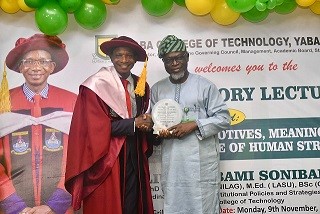
YABATECH VALEDICTORY LECTURER ADVOCATES PURPOSE-DRIVEN ADMINISTRATION, EFFECTIVE POLICY DECISIONS …Sonibare urges administrators to strengthen institutional processes, embrace mentorship and prioritise long-term development
-

Nov 26, 2026 04:10 pm
YESP DEEPENS YOUTH SKILLS DEVELOPMENT IN SOKOTO, TRAINS SERVICE PROVIDERS ON QUALITY DELIVERY
-

Nov 26, 2026 03:48 pm
YABATECH DON IDENTIFIES POOR LEADERSHIP, FUNDING DELAYS, STRIKES AS MAJOR CAUSES OF PROJECT FAILURE
-

Nov 25, 2026 05:06 pm
YABATECH RESEARCH DIRECTOR, BAGS SETPOM 2026 FELLOW AWARD
-

Nov 25, 2026 05:04 pm
UNICEF, YABATECH AND ITF NORTH WEST ZONAL OFFICE LAUNCH YOUTH SKILLS PROJECT FOR 3,400 YOUNG NIGERIANS The YESP Programme Launch and Induction Training for Training Service Providers begins Monday in Kano, marking the commencement of implementation across
-

Nov 25, 2026 05:00 pm
YABATECH COUNCIL CHAIR SAYS TECHNICAL EDUCATION KEY TO NATIONAL DEVELOPMENT …Commends futes management for building strong academic foundation
-

Nov 9, 2026 08:06 am
YABATECH ANNOUNCES 38TH CONVOCATION CEREMONIES, SETS NOVEMBER 19 FOR AWARD OF DIPLOMAS AND CERTIFICATES
-

Nov 9, 2026 08:03 am
YABATECH TO HOST FIRST VALEDICTORY LECTURE, EXPLORES THE HIDDEN X BEHIND HUMAN STRUGGLE
-

Nov 4, 2026 02:59 pm
RELEASE OF 2026/2027 ADMISSION MERIT LIST FOR NATIONAL DIPLOMA (ND) FULL TIME
-

Oct 24, 2026 08:56 pm
EXPLORE STUDY OPPORTUNITIES IN MALAYSIA!
-

Oct 23, 2026 04:53 pm
YABATECH CHARGES REGISTRY STAFF ON PROFESSIONALISM, EFFICIENCY AND DIGITAL COMPETENCE
-

Oct 20, 2026 02:02 pm
2026/2027 B.Sc(ED) Degree Merit Score
-

Oct 19, 2026 03:03 pm
INVEST, WIN DANGOTE REFINERY SHARES.
-

Oct 19, 2026 10:19 am
YABATECH VARSITY STATUS: COUNCIL CHAIR DECLARES SEASON OF THANKSGIVING, TASKS MANAGEMENT ON FUTURE
-

Oct 19, 2026 10:14 am
TINUBU ASSENTS TO BILL ESTABLISHING YABATECH AS FEDERAL UNIVERSITY OF TECHNOLOGY AND VOCATIONAL STUDIES, YABA
-

Oct 12, 2026 06:16 pm
SCHOOL OF TECHNICAL EDUCATION (STE) FINAL DEADLINE
-

Oct 12, 2026 12:37 pm
YABATECH LAUNCHES MONTHLY STAFF FITNESS EXERCISE TO PROMOTE HEALTH, PRODUCTIVITY
-

Oct 12, 2026 12:35 pm
YABATECH PARTNERS FILM INDUSTRY, ESTABLISHES CENTRE FOR FILMMAKING AND PRODUCTION
-

Oct 6, 2026 03:41 pm
YABATECH STAFF SCHOOL BOARD PRIORITISES TEACHER WELFARE, CAREER ADVANCEMENT AND QUALITY EDUCATION
-

Oct 6, 2026 03:33 pm
YABATECH CLASS OF ’86 RETURNS 40 YEARS LATER, INVESTS N100M IN ALMA MATER
-

Oct 2, 2026 04:23 pm
NIGERIA AT 66: YABATECH RECTOR FELICITATES WITH NIGERIANS, REAFFIRMS COMMITMENT TO NATIONAL DEVELOPMENT
-

Sep 30, 2026 11:44 am
YCT POLICIES
-

Sep 29, 2026 06:46 pm
APPLICATION PORTAL FOR 2026 STUDENT VENTURE CAPITAL GRANT (S_VCG COHORT)
-

Sep 27, 2026 03:00 pm
URGENT NOTICE ON JAMB REGULARIZATION - DEADLINE 30TH SEPTEMBER, 2026.
-

Sep 22, 2026 09:32 am
YABATECH RECTOR HIGHLIGHTS LEADERSHIP, INSTITUTIONAL TRANSFORMATION AS UNILAG MUSLIM ALUMNI VISIT COLLEGE
-

Sep 18, 2026 01:40 pm
YABATECH URGES STUDENTS TO TURN NIGERIA’S CHALLENGES INTO BUSINESS OPPORTUNITIES
-

Sep 18, 2026 01:35 pm
YABATECH EMERGES AS FG’S DIGITAL SKILLS HUB AS N10.5BN ACADEMY TARGETS 32,000 NIGERIANS
-

Sep 18, 2026 01:28 pm
YABATECH DON URGES NIGERIA TO EMBRACE DATA-DRIVEN GOVERNANCE, AI
-
Sep 18, 2026 01:22 pm
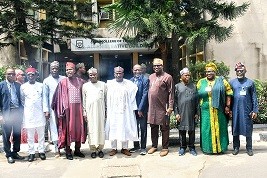
SENATE COMMITTEE INSPECTS TETFUND PROJECTS AT YABATECH, RAISES CONCERN OVER FUNDING SHORTFALLS
-

Sep 18, 2026 01:13 pm
DESTROY THE YOUTH, DESTROY NIGERIA’S FUTURE’ - YABATECH RECTOR WARNS
-

Sep 18, 2026 12:52 pm
YABATECH TRAINS OVER 50 NIGERIANS IN CNG, VEHICLE WELDING, FIRREGLASS TECHNOLOGY
-

Sep 9, 2026 10:03 am
YABATECH 2026/2027 ADMISSION CUT-OFF SCORES
-
Aug 31, 2026 05:53 pm
YABATECH TRAINS OVER 50 NIGERIANS IN CNG, VEHICLE WELDING, FIRREGLASS TECHNOLOGY
-

Aug 27, 2026 01:40 pm
STAFF VACANCIES ADVERTISEMENT (INTERNAL AND EXTERNAL)
-

Aug 22, 2026 07:22 pm
FINAL CLOSURE OF POST UTME FORM FOR 2026/2027 ACADEMIC SESSION
-

Jul 28, 2026 05:14 pm
YABATECH, AFRILABS PARTNER TO ESTABLISH DIGITAL, CREATIVE CENTRE OF EXCELLENCE FOR 2,600 YOUTHS
-
Jul 28, 2026 05:06 pm
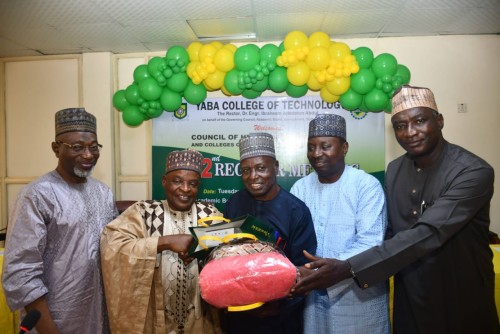
YABATECH GOVERNING COUNCIL CHAIRMAN CANVASSES STRONGER COLLABORATION TO REPOSITION TECHNICAL EDUCATION IN NIGERIA
-

Jul 28, 2026 04:52 pm
FORD FOUNDATION REAFFIRMS STRATEGIC PARTNERSHIP WITH YABATECH, BACKS YOUTH EMPOWERMENT AND ARTS DEVELOPMENT
-

Jul 28, 2026 04:35 pm
GIVE YOUR CHILD AN EDGE IN TODAY’S DIGITAL WORLD
-
Jul 26, 2026 05:37 pm
IMPORTANT NOTICE TO ALL CURRENT AND FORMER STUDENTS
-
Jul 2, 2026 01:42 pm
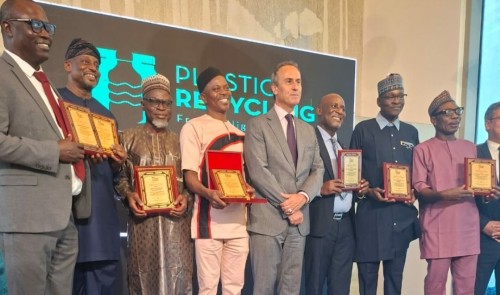
YABATECH'S PLASTOGAS HUB EARNS FRENCH ACCLAIM, SECURES NEW RESEARCH GRANT TO TACKLE PLASTIC WASTE
-
Jul 2, 2026 01:37 pm
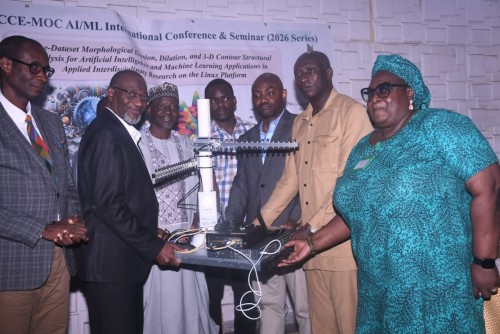
MOC-AI DONATES $20,000 AI-ML SERVER TO YABATECH, BOOSTS NIGERIA'S DIGITAL EDUCATION DRIVE
-

Jul 1, 2026 12:35 pm
YABATECH Opens Post-UTME Screening Registration for 2026/2027 Academic Session
-
Jun 29, 2026 03:45 pm
YABATECH RESEARCHERS SECURE N80 MILLION TETFUND GRANTS FOR INNOVATIVE FOOD PRESERVATION, PLASTIC WASTE-TO-ENERGY PROJECTS
-
Jun 28, 2026 08:48 pm
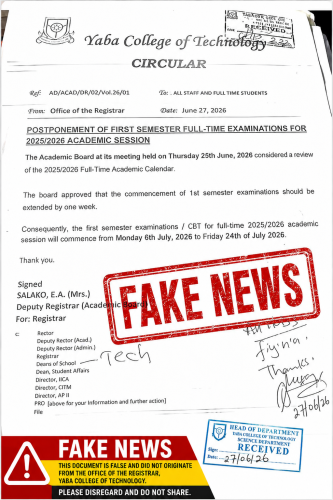
DISCLAIMER ON CIRCULATING EXAMINATION POSTPONEMENT NOTICE
-

Jun 26, 2026 02:19 pm
FUSTECH SEEKS STRATEGIC PARTNERSHIP WITH YABATECH TO DRIVE SCIENCE, TECHNOLOGY EDUCATION
-

Jun 26, 2026 02:12 pm
YABATECH'S UNIVERSITY TRANSITION NEEDS ALUMNI BACKING, SAYS COUNCIL CHAIRMAN
-

Jun 26, 2026 02:06 pm
YABATECH COUNCIL CHAIR ADVOCATES STRONGER UNIVERSITY-TRADITIONAL INSTITUTION PARTNERSHIPS FOR NATIONAL DEVELOPMENT
-

Jun 24, 2026 04:18 pm
FG, TETFUND LAUNCH 1,500-BED HOSTEL PROJECT AT YABATECH TO TACKLE ACCOMMODATION CRISIS
-

Jun 24, 2026 02:36 pm
YABATECH HONOURS OLUSI, OLORUNNIMBE, OKUFI, REWARDS 157 STAFF FOR EXCELLENCE
-

Jun 24, 2026 02:23 pm
YABATECH STUDENTS DEVELOP ELECTRIC TRICYCLE, AI FOOD DELIVERY SYSTEM
-
Jun 20, 2026 04:21 pm
YABATECH Secures N80m TETFund Grants for Research
-

Jun 18, 2026 04:38 pm
INTERFAITH HARMONY KEY TO NATIONAL UNITY, SAYS YABATECH RECTOR
-

Jun 18, 2026 04:26 pm
YABATECH DON NOMINATED TO REPRESENT NIGERIA ON FG–UNICEF COUNTRY PROGRAMME REFERENCE GROUP FOR 2028–2032
-

Jun 9, 2026 03:09 pm
NOTICE TO STUDENTS ON NELFUND LOAN DISBURSEMENT
-

Jun 2, 2026 02:33 pm
US CONSULATE, YABATECH TRAIN OVER 300 STAFF ON RESPONSIBLE AI USE
-

Jun 2, 2026 02:31 pm
COREG HONOURS YABATECH RECTOR ...PUSHES FOR DIGITAL REFORMS IN POLY ADMINISTRATION
-
Jun 2, 2026 02:29 pm
POLICY GAPS, FRAGMENTED PLANNING CRIPPLING NIGERIA’S TRANSPORT SYSTEM - DON
-

Jun 2, 2026 02:09 pm
YABATECH STRENGTHENS RESEARCH CAPACITY AS 46 STAFF COMPLETE ADVANCED DIGITAL SURVEY TRAINING
-

Jun 2, 2026 01:56 pm
YABATECH, STERLING BANK PARTNER TO BRIDGE ACADEMIA - INDUSTRY SKILLS GAP
-

Jun 2, 2026 01:42 pm
NBTE, YABATECH CALL FOR DATA-DRIVEN POLICY SHIFT AS DIGITAL PLATFORMS TAKE CENTRE STAGE IN TECHNICAL/VOCATIONAL EDUCATION REFORM
-

Jun 2, 2026 01:31 pm
FG APPOINTS YABATECH RECTOR, OTHERS AS MEMBERS OF WORLD SKILLS NIGERIA NATIONAL WORKING COMMITTEE
-

Jun 2, 2026 01:11 pm
CANADA, UNICEF EXPLORE EXPANSION OF YOUTH EMPOWERMENT INITIATIVE AT YABATECH
-

Jun 2, 2026 11:56 am
COREN IDENTIFIES YABATECH AS NIGERIA'S STRATEGIC PLATFORM FOR SYDNEY, DUBLIN ACCORDS IN LANDMARK ACCREDITATION
-

Jun 2, 2026 11:19 am
RECTOR REITERATES COMMITMENT TO PRODUCING QUALITY GRADUATES AS YABATECH SEALS PARTNERSHIP DEAL WITH JOHN BASIL MANDILAS FOUNDATION ON STRATEGIC HVAC-R TRAINING FOR STUDENTS
-

Apr 29, 2026 09:02 am
YASUG ELECTION VOTERS LIST
-

Apr 22, 2026 04:31 pm
ATTENTION PLEASE!!!!!
-

Apr 15, 2026 03:37 pm
YABATECH STUDENTS' UNION ELECTION 2026.
-

Apr 9, 2026 12:28 pm
ACKNOWLEDGEMENT OF RECEIPT OF NELFUND LOAN
-

Mar 17, 2026 06:54 pm
INDECENT DRESSING/POSTURE AND APPROPRIATE SANCTIONS
-

Feb 17, 2026 11:30 am
IMPORTANT NOTICE TO HND FULL-TIME APPLICANTS
-

Jan 15, 2026 01:39 pm
NOTICE TO STUDENTS WITH OUTSTANDING PRE-MEDICAL FEES
-
Jan 6, 2026 11:39 am
YABATECH Charges Newly Recruited Staff on Integrity, Excellence, Zero Tolerance for Corruption
-

Jan 3, 2026 09:02 am
2025/2026 SCREENING AND REGISTRATION OF NEWLY ADMITTED ND1 PART TIME CANDIDATES
-

Dec 26, 2025 05:52 pm
Lai Mohammed Donates Book on Governance, Media and Nation-Building to YABATECH
-

Dec 14, 2025 03:30 am
CHANGE OF COURSE FORM IS NOW AVAILABLE
-

Dec 12, 2025 09:38 am
YABATECH SHINES AS BEST TOURISM TERTIARY INSTITUTION IN SOUTHWEST NIGERIA: COLLEGE CLINCHES TOP AWARD AT 2025 SOUTHWEST INTERNATIONAL TOURISM EXPO
-

Dec 11, 2025 05:16 pm
FIRST BANK TECHS YABATECH WITH DIGITAL EXPERIENCE
-
Dec 11, 2025 05:10 pm
BOOST FOR YABATECH STUDENTS AS CIS UNVEILS FUNDING, TRAINING AND CAREER OPPORTUNITIES
-

Dec 11, 2025 05:04 pm
FG CONSIDERS REPORT FOR TRANSFORMATION OF YABATECH TO YABA TECHNICAL AND VOCATIONAL UNIVERSITY- TINUBU ASSURES, SAYS 960,000 TRAINEES ENROL FOR VOCATIONAL ENTERPRISE INSTITUTE
-

Dec 11, 2025 04:58 pm
NATIONAL ASSEMBLY ASSURES NIGERIAN YOUTHS OF LEGISLATION TO BOOST DIGITAL ECONOMY TO CREATE MORE JOBS
-

Dec 11, 2025 04:46 pm
YABATECH 37TH CONVOCATION LECTURE: THIS IS THE LAST, UNIVERSITY IS ON THE WAY-SENATE LEADER, BAMIDELE
-

Dec 10, 2025 12:33 pm
PRESIDENTIAL TAX REFORMS COMMITTEE CHAIRMAN TASKS YABATECH, OTHERS ON COMPETENCY-BASED LEARNING, DIGITAL LITERACY
-

Dec 10, 2025 12:26 pm
YABATECH CELEBRATES INGENIOUS RESEARCH FEAT IN GAS GENERATION FROM WASTE PLASTIC, GETS ACCREDITATION FOR MORE COURSES
-

Dec 10, 2025 12:20 pm
SENATE MAJORITY LEADER, BAMIDELE TO DELIVER YABATECH CONVOCATION LECTURE
-
Dec 10, 2025 12:08 pm
YABATECH PRODUCES 291 DISTINCTION GRADUANDS, HOLDS 37TH CONVOCATION ON THURSDAY, UNVEILS BUA GROUP CHAIRMAN, SENATE LEADER, SEN. OLAMILEKAN AS FELLOWSHIP AWARDEES
-

Dec 10, 2025 12:02 pm
YABATECH, EKITI PARTNER TO UNLOCK TOURISM POTENTIALS FOR NATIONAL DEVELOPMENT IN IYIN KINGDOM
-

Dec 10, 2025 09:51 am
ECOBANK PARTNERS YABATECH ON LAUNCHING OF LAGOS POP-UP MUSEUM TO PROMOTE ART, INNOVATION, YOUTH EMPOWERMENT
-

Dec 9, 2025 05:00 pm
IMPORTANT NOTICE TO ALL HND APPLICANTS FOR THE 2025/2026 ACADEMIC SESSION
-

Dec 5, 2025 03:26 pm
APPLICATION FOR ADMISSION INTO HIGHER NATIONAL DIPLOMA (FULL TIME) PROGRAMMES FOR THE 2025/2026 ACADEMIC SESSION
-

Dec 2, 2025 04:57 pm
YABATECH, IDEAS-TVET INITIATIVE FLAG OFF YOUTH EMPLOYMENT THROUGH SKILLS ACQUISITION FUND
-

Dec 2, 2025 04:49 pm
YABATECH LAUNCHES HASSAN SUNMONU CENTRE FOR LEADERSHIP AND GOVERNANCE, CHARTS PATH FOR AFRICA’S DEMOCRATIC RENEWAL
-

Dec 1, 2025 02:48 pm
LAGOS NEEDS INTEGRATED URBAN PLANNING TO ACHIEVE SUSTAINABLE MOBILITY – YABATECH DON
-

Dec 1, 2025 02:42 pm
GOV SANWO-OLU SETS TO REBUILD YABATECH BURNT HOSTEL AS CONTRACTOR TAKES OVER CONSTRUCTION SITE
-

Dec 1, 2025 02:33 pm
HOUSE OF REPS COMMITTEE BEGINS PROBING OF ALLEGED CERTIFICATE RACKETEERING IN NIGERIAN TERTIARY INSTITUTIONS, LAUDS YABATECH INSTITUTIONAL SAFEGUARDS
-
Dec 1, 2025 02:26 pm
CHAI AND YABATECH CELEBRATE 2025 INTERNATIONAL DAY OF THE GIRL CHILD
-

Dec 1, 2025 02:17 pm
YABATECH, SEMICOLON SIGN MOU ON HUMAN CAPITAL DEVELOPMENT
-

Nov 28, 2025 05:38 pm
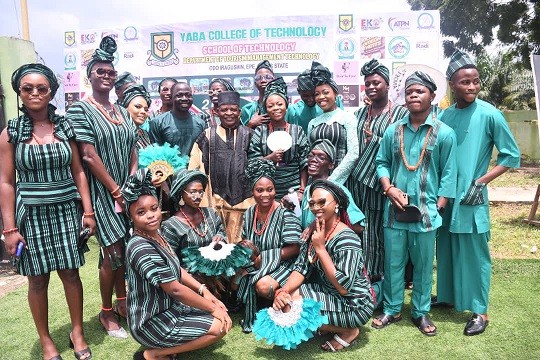
YABATECH ALUMNI LIGHT UP CAMPUS
-
Nov 28, 2025 05:30 pm
YABATECH COUNCIL'S CHAIR WANTS STAKEHOLDERS TO EMBRACE INNOVATION TO SUSTAIN TRANSFORMATION IN TOURISM
-
Nov 28, 2025 05:23 pm
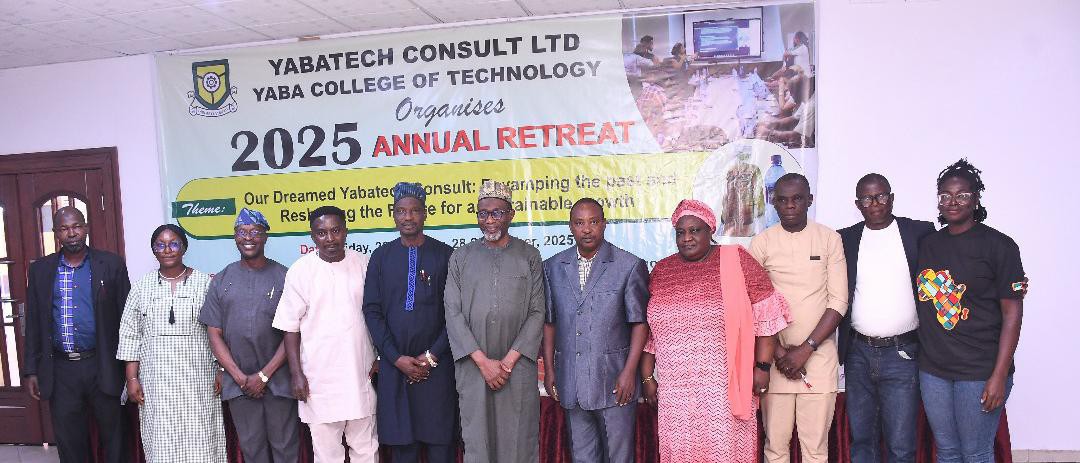
YABATECH CONSULT CHARGED TO CHARTS PATH FOR SUSTAINABLE GROWTH
-

Nov 28, 2025 05:17 pm
LOTUS BANK, YABATECH SEAL STRATEGIC PARTNERSHIP TO DRIVE DIGITAL INNOVATION, STUDENT EMPOWERMENT
-
Nov 28, 2025 05:09 pm
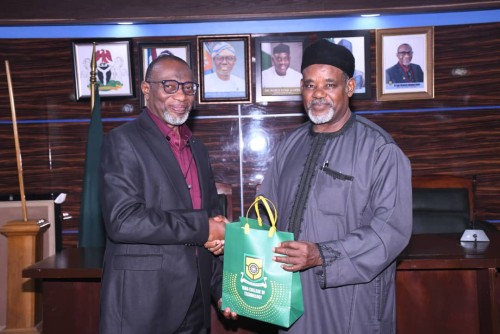
SULTAN, YABATECH EXPLORE PARTNERSHIP TO DRIVE EDUCATION AND COMMUNITY DEVELOPMENT
-

Nov 25, 2025 03:11 pm
YABATECH DON TRACES INCESSANT BUILDING COLLAPSE IN NIGERIA TO POOR COMMUNICATION
-

Nov 17, 2025 01:34 pm
YABATECH Researchers Secure Over ₦62 Million in Prestigious TETFund/NRF Research Grants
-

Nov 17, 2025 12:16 pm
PAYMENT INSTRUCTION FOR GRADUANDS
-

Nov 15, 2025 11:59 am
NOTICE TO ALL GRADUANDS
-

Nov 11, 2025 06:56 pm
IMPORTANT NOTICE ON 2025/2026 Post-UTME Screening Application
-
Nov 7, 2025 09:34 am
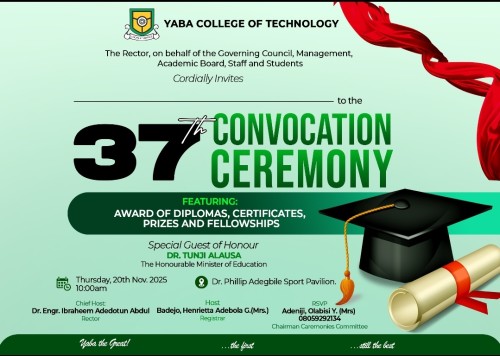
Honouring achievement, excellence, and the future — YABATECH 37th Convocation Ceremony.
-

Nov 5, 2025 02:26 pm
Important Notice For part time Student: School Fees Payment and Registration Deadline
-

Oct 14, 2025 02:04 pm
NOTICE TO SHORTLISTED CANDIDATES FOR RECRUITMENT CBT
-
Sep 30, 2025 02:27 pm
YABATECH Researchers Secure Over ₦62 Million in Prestigious TETFund/NRF Research Grants
-

Sep 26, 2025 12:56 pm
DISCLAIMER: FALSE INFORMATION ON RECRUITMENT REAPPLICATION
-

Sep 24, 2025 02:10 pm
REOPENING OF STAFF VACANCIES ADVERTISEMENT (INTERNAL AND EXTERNAL) PORTAL
-

Sep 21, 2025 03:49 am
YABATECH 2025/2026 POST UTME ADMISSION APPLICATION
-

Aug 20, 2025 05:41 pm
2024/2025 Academic Session Screening Exercise Ends On Thursday,August 21,2025
-

Aug 18, 2025 02:45 pm
YABATECH GIRLS SKILLS PROGRAMME WINS GLOBAL PRAISE, TARGETS ADDITIONAL TRAINING OF 1M GIRL-CHILD
-

Aug 18, 2025 02:30 pm
YABATECH SEEKS FORD FOUNDATION SUPPORT ON PROPOSED GIRL CHILD ENTERPRISE, INNOVATION HUBS
-

Aug 16, 2025 09:04 pm
FULLTIME STUDENTS PRINTING OF 2024/2025 FIRST SEMESTER EXAMINATION DOCKETS
-

Aug 16, 2025 06:57 pm
STAFF VACANCIES ADVERTISEMENT (INTERNAL AND EXTERNAL)
-

Aug 11, 2025 02:00 pm
YABATECH, CIG STRENGHTEN PARTNERSHIP AS SPONSORED STUDENTS IN CHINA WIN N3M SCHOLARSHIPS
-

Aug 8, 2025 10:50 am
2025/2026 ADMISSIONS INTO PART-TIME PROGRAMME FOR NATIONAL DIPLOMA
-

Aug 6, 2025 04:00 pm
POSTPONMENT OF FIRST SEMESTER 2024/2025 FULL TIME EXAMINATION
-

Aug 6, 2025 01:01 pm
YABATECH, UNICEF EMPOWER 200 GIRLS WITH SKILLS, GLOBAL CERTIFICATION, AND STARTUP TOOLKITS
-
Aug 6, 2025 12:54 pm
YABATECH COUNCIL MARKS ONE YEAR STRATEGIC IMPACTS CREATES CENTRE FOR PEACE AND CONFLICT RESOLUTION
-

Aug 6, 2025 12:41 pm
YABATECH MATRICULATES 12,000 STUDENT FROWNS AT INDECENT DRESSING
-

Jul 22, 2025 06:42 pm
COMMENCEMENT OF 2025/2026 SCREENING AND REGISTRATION OF NEWLY ADMITTED HND1 PART TIME CANDIDATES
-

Jul 16, 2025 05:14 pm
YABATECH COMMISERATES WITH PRESIDENT BOLA TINUBU OVER THE DEATH OF BUHARI
-

Jul 16, 2025 04:57 pm
YABATECH RECTOR CALLS FOR GLOBAL VISIBILITY THROUGH QUALITY RESEARCH AND PUBLICATION
-

Jul 16, 2025 04:57 pm
YABATECH RECTOR CALLS FOR GLOBAL VISIBILITY THROUGH QUALITY RESEARCH AND PUBLICATION
-

Jul 16, 2025 04:40 pm
Yabatech Staff Schools Launch Tech Hub, Honour Rector
-

Jul 16, 2025 04:08 pm
2025 MATRICULATION CEREMONY
-

Jul 11, 2025 03:07 pm
YABATECH RECTOR GIVES 20 JUSTIFICATIONS FOR RENAMING IT YABA TECHNICAL AND VOCATIONAL UNIVERSITY TO MAINTAIN SCHOOLS ACRONYMN
-

Jul 11, 2025 02:52 pm
NAPS BACKS YABATECH TRANSFORMATION TO TVET VARSITY, DROPS AGITATION AS RECTOR COUNSELS
-

Jul 11, 2025 02:44 pm
Technical Education, A Strong National Development Instrument – Ilaro Poly Rector
-

Jul 11, 2025 02:35 pm
PRACTICAL SKILLS UNDERVALUED IN NIGERIA – ACE BROADCASTER
-
Jul 11, 2025 02:25 pm
YABATECH DON CALLS FG TO USE DATA AND STATISTICS TO SOLVE NATIONAL PROBLEMS
-
Jul 11, 2025 02:15 pm
YABATECH SETS TO OPEN CENTRE OF EXCELLENCE IN OPTOMETRY
-

Jul 11, 2025 02:05 pm
EX LAGOS PERM SEC IDENTIFIES BANES IN NIGERIA ADVANCEMENT
-
Jul 11, 2025 01:51 pm
YABATECH SEND FORTHS 80 RETIREES IN POMP
-

Jul 11, 2025 01:42 pm
Icpc Inaugurates Yabatech Anti Corruption Unit As Rector Reaffirms Commitment To Transparency
-
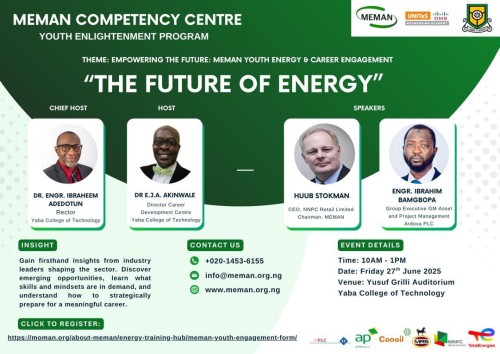
Jun 27, 2025 08:52 am
MEMAN COMPETENCY CENTRE YOUTH ENLIGHTENMENT PROGRAM
-

Jun 25, 2025 11:51 am
CHANGE OF COURSE EXTENSION: FOR 2024/2025 AVAILABLE NATIONAL DIPLOMA & B.SC (EDU.) PROGRAMMES
-

Jun 20, 2025 01:41 pm
2025/2026 ADMISSION INTO PART-TIME PROGRAMMES FOR HIGHER NATIONAL DIPLOMA (HND)
-

Jun 10, 2025 11:43 am
YABATECH INSTITUTES FOLAWIYO LECTURE SERIES
-

Jun 7, 2025 10:13 am
EID EL ADHA MUBARAK
-

Jun 5, 2025 03:47 pm
RELEASE OF 2024/2025 ACADEMIC SESSION SUPPLEMENTARY LIST FOR HIGHER NATIONAL DIPLOMA (HND) FULL TIME
-

Jun 1, 2025 01:55 pm
FOLAWIYO ENTREPRENEURSHIP CENTRE MAIDEN BUSINESS IDEA COMPETITION
-
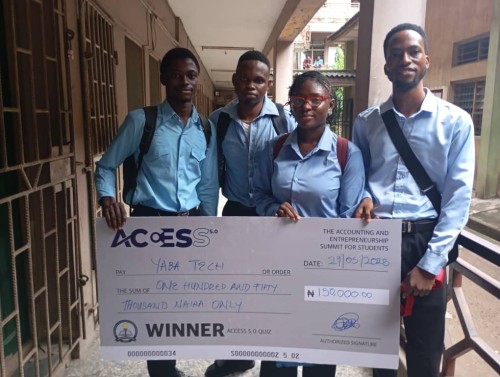
May 30, 2025 11:30 am
YABATECH HND STUDENTS WIN ACCOUNTANCY QUIZ COMPETITION
-

May 27, 2025 03:50 pm
RELEASE OF 2024/2025 ACADEMIC SESSION MERIT LIST FOR HIGHER NATIONAL DIPLOMA (HND) FULL TIME
-

May 26, 2025 10:16 am
YABATECH RECTOR CHARGES STAFF TO DEMONSTRATE HIGH LEVEL OF PROFESSIONALISM …AS HE BEGINS THIRD YEAR IN OFFICE
-

May 19, 2025 11:44 am
YABATECH RECEIVES 2025 ICAN CORPORATE MERIT AWARD
-

May 16, 2025 01:16 pm
YABATECH RECTOR IN SOLIDARITY WITH JAMB LEADERSHIP AMIDST 2025 UTME CHALLENGES
-

May 16, 2025 12:59 pm
YABATECH SET FOR TRANSFORMATION INTO YABA FEDERAL UNIVERSITY OF TECHNOLOGY AND VOCATIONAL STUDIES
-

May 16, 2025 12:39 pm
POVERTY DEPRIVES DEVELOPING NATIONS FROM AI GAINS - YABATECH DON
-

May 16, 2025 12:30 pm
YABATECH DON URGES NIGERIA TO EMBRACE AI FOR NATIONAL DEVELOPMENT, WARNS OF GROWING GLOBAL GAP
-

May 16, 2025 12:23 pm
AI INTEGRATION CRITICAL TO NIGERIAS FUTURE, SAYS DR OT RAHEEM
-
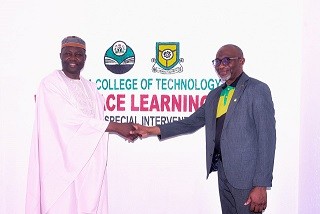
May 16, 2025 11:58 am
TETFUND SCORES YABATECH HIGH ON PROJECT EXECUTION …COMMISSIONS WORKPLACE LEARNING HUB
-

May 16, 2025 11:48 am
YABATECH NOT EMBROILED IN ILLEGAL DEDUCTION OF STUDENTS LOAN - MANAGEMENT
-

May 16, 2025 11:34 am
YABATECH, A FERTILE GROUND FOR INDUSTRY PARTNERSHIP & MODEL FOR NURTURING TALENTS FOR NATIONAL GLOBAL STANDARD – ROYAL FRIESLANDCAMPINA CEO
-
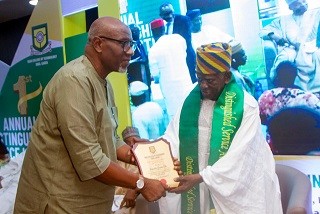
May 16, 2025 11:24 am
YABATECH APPRECIATES 150 STAFF WITH DISTINGUISHED SERVICE AWARDS
-

May 16, 2025 11:16 am
YABATECH EMERGES 2ND OVERALL BEST AT 22ND NIPOGA IN OFFA
-

May 16, 2025 10:57 am
TRANSFORMATION OF YABATECH TO UNIVERSITY, ITS FG BIRTHDAY GIFT TO ME- FANIMOKUN … PLEGDES EDIFICE BUILDINGS AT TAKE OFF
-

May 16, 2025 10:45 am
YABATECH BECOMES TRAIL BLAZER, TRAINS NIGERIA FIRST SET OF OVER 40 TRAINEES IN GENDER RESPONSIVE PEDAGOFY TRAINING & CERTIFICATION
-

May 15, 2025 03:03 pm
ICPC SEEKS ROBUST RELATIONSHIP WITH YABATECH
-

May 15, 2025 02:53 pm
FRENCH EMBASSY LAUDS YABATECH RESEARCH STRIDES ON PLASTOGAS HUB
-

May 15, 2025 02:40 pm
UNIVERSITY OF KWAZULU - NATAL SETS TO SIGN PACT WITH YABATECH ON PG PROGRAMS
-

May 15, 2025 02:31 pm
INTERSWITCH MOVES TO ENHANCE DIGITAL EDUCATION, DONATE N45M ICT EQUIPMENT TO YABATECH
-

May 15, 2025 02:22 pm
ICAN RATES YABATECH AS MAJOR PRODUCER OF CHARTERED ACCOUNTANTS IN NIGERIA
-

May 15, 2025 02:10 pm
SKILLS DEVELOPMENT: A TOOL FOR ADDRESSING SOCIETAL CHALLENGES, SAYS YABATECH COUNCIL CHAIR
-

May 15, 2025 01:54 pm
4TH ANNUAL TPL (DR) ABUBAKAR MOBOLAJI OLASENI LECTURE, DON WORRIES OVER POOR PRESERVATION OF NIGERIA CULTURAL HERITAGE
-

May 13, 2025 04:41 pm
YABATECH RECTOR CHARGES JAMB APPLICANTS TO ENROL FOR SUSTAINABLE SKILLS COURSES IN TERTIARY INSTITUTIONS
-

May 13, 2025 04:29 pm
YABATECH RECTOR CALLS ON INDUSTRIES TO PARTNER NIGERIAN INSTITUTIONS, TO BRIDGE TOWN, GOWN GAP
-

May 13, 2025 04:05 pm
YABATECH PARTNERS FG TO TRAIN TEACHERS, INSTRUCTORS AT GOVT SKILLS TECHNICAL CENTERS, VOCATIONAL EDUCATION INSTITUTIONS
-

May 13, 2025 03:50 pm
YABATECH WINS BEST TERTIARY TOURISM INSTITUTION AWARD IN LAGOS
-

May 2, 2025 09:54 am
Nelfund N71bn Missing Fund: Yabatech Not Embroiled In Illegal Deduction Of Student Loan
-
Apr 22, 2025 02:20 am
CAREERLEAP SERIES 1: INDUSTRY AND ACADEMIA ENGAGEMENT SESSION
-

Apr 17, 2025 02:45 pm
RECTOR EASTER MESSAGE
-

Apr 17, 2025 11:26 am
17TH INAUGURAL LECTURE - CAPACITANCE OF ARTIFICIAL INTELLIGENCE: COMMUNICATION, FRAMING AND LEARNING IN A GROWING ECONOMY
-

Apr 4, 2025 05:06 pm
NOTICE TO ALL FULL TIME HND APPLICANTS FOR 2024/2025 SESSION
-

Apr 4, 2025 05:06 pm
NOTICE TO ALL HND FULL TIME APPLICANTS IN THE SCHOOL OF ARTS, DESIGNS AND PRINTING FOR 2024/2025 SESSION
-

Mar 31, 2025 02:14 pm
RECTOR'S EID MESSAGE
-

Mar 26, 2025 01:13 pm
FINAL NOTICE TO CANDIDATES WHO CHOSE YABA COLLEGE OF TECHNOLOGY (YABATECH) AS THEIR FIRST CHOICE FOR THE 2024/2025 ACADEMIC SESSION
-

Mar 22, 2025 08:21 am
RELEASE OF 2024/2025 ACADEMIC SESSION SUPPLEMENTARY LIST FOR NATIONAL DIPLOMA (ND) FULL TIME
-

Mar 18, 2025 02:29 pm
NBTE Reviewed Requirement For Hnd Admission.
-

Mar 6, 2025 03:58 pm
PROCEEDINGS OF THE 1ST INTERNATIONAL CONFERENCE OF SCHOOL OF AGRICULTURAL TECHNOLOGY, YABA COLLEGE OF TECHNOLOGY
-

Mar 4, 2025 04:27 pm
RELEASE OF 2024/2025 ACADEMIC SESSION MERIT LIST FOR NATIONAL DIPLOMA (ND) FULL TIME
-

Feb 26, 2025 02:17 pm
Students Union Election 2025 Time Extension.
-

Feb 24, 2025 10:29 am
STUDENTS UNION ELECTION 2025 VOTING PROCEDURES
-

Feb 21, 2025 03:17 pm
STUDENTS UNION ELECTION 2025 LIST OF QUALIFIED ASPIRANTS
-

Feb 20, 2025 12:07 pm
EXTENSION OF STUDENTS UNION ELECTION 2025 NOMINATION FORMS
-

Feb 15, 2025 08:24 pm
PRESIDENT TINUBU APPROVES CONVERSION OF YABATECH TO UNIVERSITY
-

Feb 13, 2025 01:28 pm
YABA COLLEGE OF TECHNOLOGY STUDENTS UNION ELECTION 2025
-

Feb 12, 2025 08:59 pm
APPLICATION FOR ADMISSION INTO HIGHER NATIONAL DIPLOMA (FULL TIME) PROGRAMMES FOR THE 2024/2025 ACADEMIC SESSION
-

Feb 11, 2025 05:26 pm
Yaba College Of Technology Students Union Election 2025.
-

Feb 7, 2025 07:31 pm
IMPORTANT NOTICE TO ALL 2024/2025 FULL TIME ADMISSION APPLICANTS
-

Feb 7, 2025 08:43 am
RELEASE OF 2024/2025 ADMISSION CUTOFF MARK
-

Jan 28, 2025 06:18 pm
DISCLAIMER - POSTUTME RESULT DISQUALIFICATION
-

Jan 26, 2025 03:33 pm
NOTICE TO ALL POSTUME APPLICANT
-

Dec 31, 2024 10:27 am
Yabatech Partners FG to train Govt Skills Technical Centres, Vocational Teachers, Instructors
-

Dec 28, 2024 09:01 am
YABATECH Wins Best Tertiary Tourism Institution Award
-

Dec 27, 2024 06:42 am
YABATECH Post UTME FORM 2024/2025 [DEADLINE EXTENDED]
-

Dec 19, 2024 10:21 am
Yabatech And Friesland Campina Wamco Forge Strategic Partnership With New Mou
-

Dec 13, 2024 03:42 pm
Post Utme For 2024/2025 Closes On December 16, 2024
-

Dec 12, 2024 09:50 am
The Governing Council Appoints New Registrar And Bursar
-

Dec 6, 2024 12:55 pm
Vote Your Preferred Anthem
-

Dec 3, 2024 09:50 am
FUOYE-YABATECH TOP UP EXTERNAL DEGREE APPLICATION FORM HND CONVERSION PROGRAM
-

Nov 30, 2024 03:34 pm
Continuation Of Online Classes And Postponement Of Hostel Resumption
-

Nov 28, 2024 03:57 pm
Important Update On School Fees Payment For Full Time And Part Time Students
-

Nov 28, 2024 02:19 pm
Successful Convocation Programme: Profound Gratitude
-

Nov 27, 2024 10:07 am
Agroween 2024
-
Nov 26, 2024 07:58 am
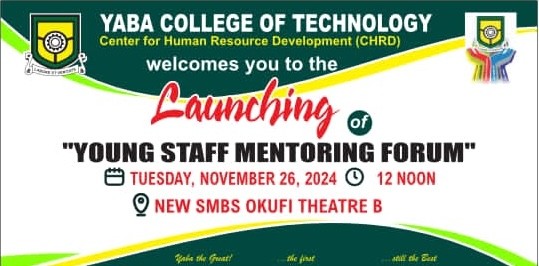
Change of Venue for the Launching Of Young Staff Mentoring Forum
-
Nov 25, 2024 11:31 am
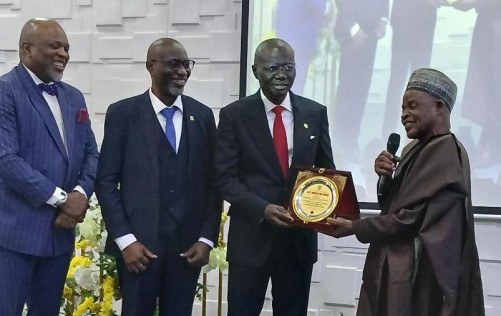
Value Addition, Export Diversification Crucial For Nigeria’s Economic Recovery – Sanwo-olu
-

Nov 25, 2024 11:28 am
Yabatech Has Achieved Significant Milestones In The Area Of Entrepreneurial Development- Bola Tinubu
-

Nov 22, 2024 10:28 am
First Lady’s N50m Endowment Fund For Yabatech Best Female Student.
-

Nov 20, 2024 03:05 pm
Sanwo-olu Tasks Yabatech On Homegrown Tech Solutions
-

Nov 20, 2024 09:46 am
How Nigeria Can Use Export To Achieve Economic Recovery – Shetimma, Sanwo-olu
-

Nov 19, 2024 04:55 pm
Yabatech Graduates 8,139 Students, 316 Bag Distinction
-

Nov 19, 2024 04:49 pm
Yaba College Of Technology 36th Convocation Ceremony
-
Nov 19, 2024 04:44 pm
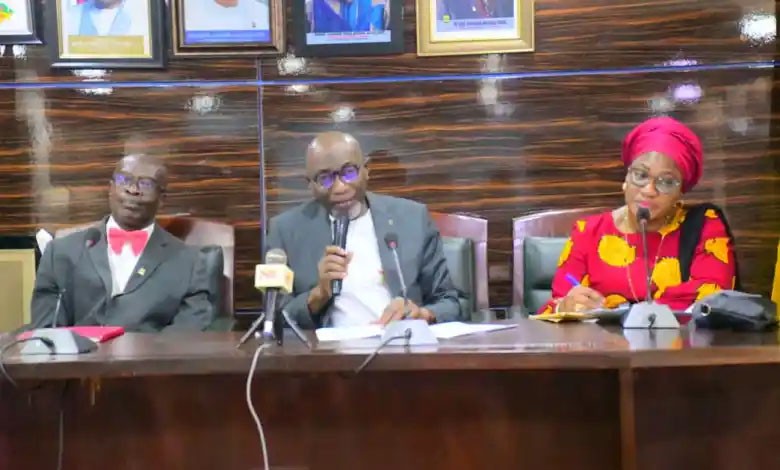
Yabatech To Honor First Lady, Remi Tinubu, Speaker Abass At 36th Convocation
-
Nov 19, 2024 04:40 pm
#yabatech36thconvocation Is Here!
-

Nov 15, 2024 04:01 pm
Beware Of Extortionists.
-

Nov 4, 2024 02:07 pm
School Of Management And Business Studies 2nd International Conference 2024
-
Nov 1, 2024 02:53 pm
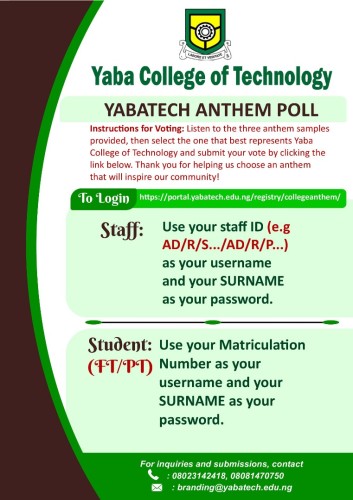
Yabatech Anthem Poll: Make Your Voice Heard!
-

Oct 29, 2024 12:57 pm
Yabatech Rector Seeks Upgrade Of Record To Bachelor's Degree
-

Oct 19, 2024 06:10 pm
Important Notice For Part Time Student: School Fees Payment And Registration Deadline
-

Oct 17, 2024 05:01 pm
Post- Utme Screening For 2024/2025 Admission Exercise
-
Oct 17, 2024 01:33 pm
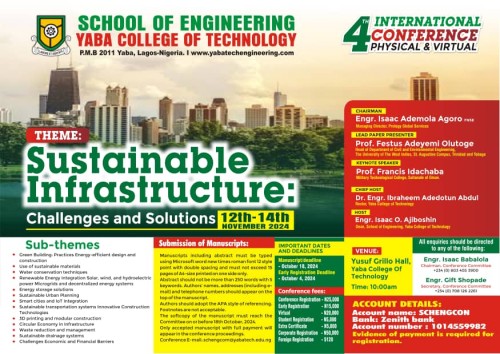
School Of Engineering 4th International Conference
-

Oct 16, 2024 12:19 pm
Commencement Of 2024/2025 Screening And Registration Of Newly Admitted ND1 Part-time Candidates
-

Oct 12, 2024 02:35 pm
Payment Portal Update For Yabatech Students
-

Oct 14, 2024 05:14 am
Rescheduling Of Learning Activities And Examination Registration To Online Platform For Full-time and Part-time Students.
-

Oct 11, 2024 03:14 pm
Release Of Part-time Admission List
-

Oct 11, 2024 12:12 pm
Opportunity for Migration to Distance Learning Mode through CODFeL Program
-

Oct 1, 2024 01:20 pm
64TH INDEPENDENCE DAY: LET'S HONOUR THE STRENGTH OF OUR DIVERSITY
-
Sep 29, 2024 06:52 pm
A Multimedimensional Speech Delivered By Prof. F.i Owa Afolabi At The 2024 United Nations World Tourism Day Celebrations On Tourism And Peace
-

Sep 24, 2024 08:42 am
SUSPENSION OF LECTURES FOR PART-TIME PROGRAMME
-
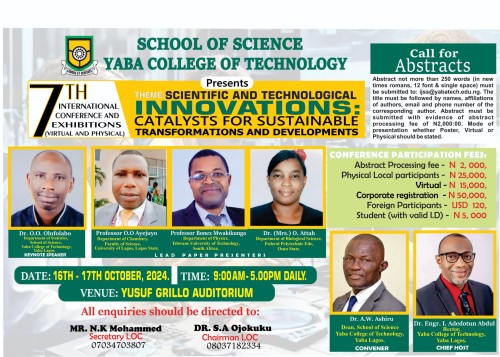
Sep 12, 2024 04:27 pm
School Of Science 7th International Conference And Exhibitions
-

Sep 9, 2024 03:40 pm
Communique On 3-day Retreat
-

Sep 6, 2024 10:38 am
ND/HND Supplementary List
-

Sep 4, 2024 04:34 pm
FUOYE-YABATECH External Degree Affiliation Program Admission 2025/2026
-

Sep 4, 2024 10:45 am
2023/2024 Matriculation Ceremony
-

Sep 3, 2024 11:26 am
Yabatech In Darkness As Ikeja Electric Fails To Fix Meter.
-
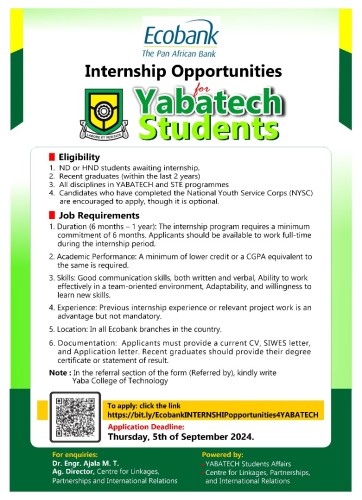
Sep 2, 2024 11:17 am
Yabatech Partners With Ecobank
-

Aug 28, 2024 01:19 pm
Nelfund Application Process
-

Aug 16, 2024 11:48 am
Student Application Loan
-

Aug 15, 2024 10:44 am
Resumption Of Physical Lectures For Part Time Students.
-

Aug 8, 2024 02:41 pm
Students Registration
-

Aug 4, 2024 07:23 am
LECTURES CONTINUE VIRTUALLY:BEWARE OF FAKE CIRCULAR
-

Jul 31, 2024 12:18 pm
IMPORTANT UPDATE ON CAMPUS SAFETY AND ACADEMIC ACTIVITIES
-

Jul 29, 2024 11:41 am
Town And Gown Synergy
-

Jul 28, 2024 07:19 am
DISCLAIMER
-
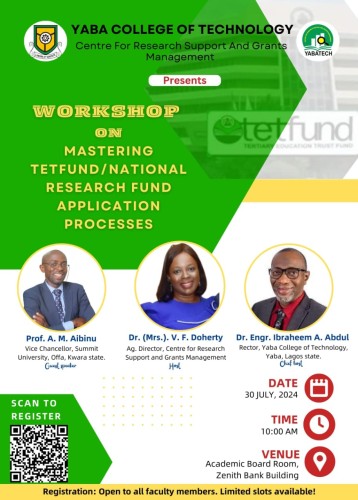
Jul 26, 2024 11:22 am
Workshop On Mastering Tetfund/national Research Fund Application Processes.
-

Jul 15, 2024 10:32 am
Part-time Students Resume, Monday, July 29,2024.
-
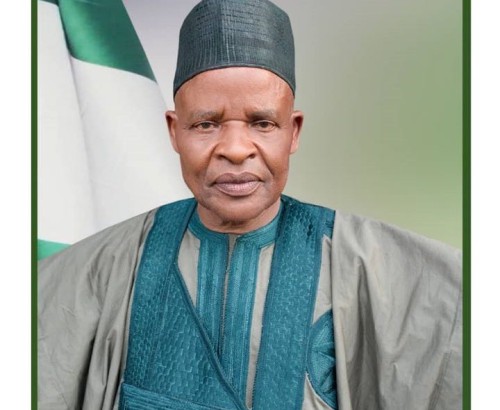
Jul 15, 2024 10:29 am
Yabatech Governing Council Assumes Duty On Monday, July 22
-

Jul 4, 2024 02:55 pm
Admission List .
-

Jul 3, 2024 12:23 pm
Appeal For A Little Patience
-

Jun 6, 2024 03:18 pm
YABATECH RECTOR, A TECHNOLOGY GAME CHANGER - TUNDE FANIMOKUN
-

Jun 6, 2024 02:22 pm
APPLICATION FOR HOSTELS IN THE COLLEGE
-

Jun 6, 2024 11:54 am
COMMENCEMENT OF LECTURES AND FEE PAYMENT GUIDELINES
-

May 21, 2024 01:48 pm
YABATECH RECTOR INDUCTED INTO AFRICAN LEGENDARY HALL OF FAME
-
May 21, 2024 01:41 pm
RED ALERT: BEWARE OF EXTORTIONISTS ON SALE OF FAKE HOSTEL FORM
-

May 20, 2024 10:44 am
BREAKING NEWS: YABATECH SECURES 1.5 BILLION NAIRA GRANT FOR GIRLS EDUCATION AND SKILLS PARTNERSHIP
-

May 20, 2024 10:10 am
RECTOR 365 DAYS IN OFFICE PUBLIC LECTURE
-

May 17, 2024 03:36 pm
CODFEL Admission List
-

May 15, 2024 12:19 pm
Yabatech Rector 365 Days In The Office
-

May 14, 2024 11:37 am
Yabatech Rector’s 365 Days In Office
-

May 11, 2024 02:53 am
STE SUPPLEMENTARY ONE AND ND SUPPLEMENTARY THREE ADMISSION LIST
-

May 10, 2024 03:05 pm
Reprint Your Clearance Slip
-

May 10, 2024 10:01 am
Procedure For Online & Physical Screening For New Students.
-

May 9, 2024 08:36 pm
PAYMENT FOR PRE MEDICAL SCREENING FOR FRESH STUDENTS
-

May 7, 2024 12:27 pm
Yabatech Organises 5days Girls Education Skills
-

May 7, 2024 08:45 am
YABATECH, UNICEF TO EMPOWER ONE MILLION NIGERIAN GIRLS
-

Apr 30, 2024 09:06 pm
Rector’s Workers’ Day Goodwill Message
-

Apr 26, 2024 05:05 pm
Postponement Of Physical Resumption
-

Apr 26, 2024 04:50 pm
Obtain National Diploma At Your Convenience Under CODFEL.(Centre for Open,Distance and Flexible e-Learning)
-

Apr 24, 2024 09:08 am
FAGBEMI LAUDS YABATECH MANAGEMENT DEVELOPMENTAL AND ACADEMIC SUCCESS RECORD
-

Apr 24, 2024 09:02 am
YABATECH TO TRAIN INFORMAL SECTORS FOR GLOBAL CERTIFICATION
-

Apr 16, 2024 02:54 pm
FANIMOKUN GIVES 150 ACRES OF LAND TO YABATECH FOR GREEN CAMPUS
-
Apr 15, 2024 11:13 am
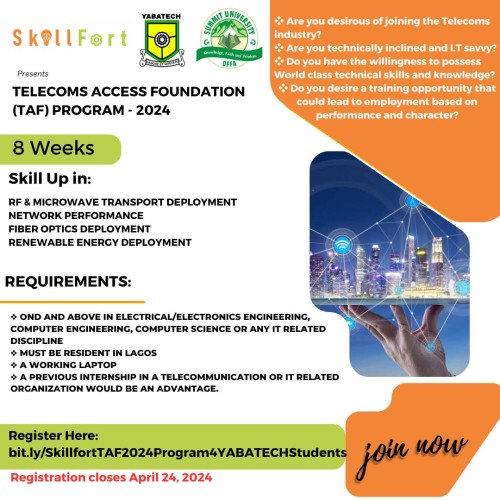
8-week Telecommunication Training For Yabatech Graduating Students
-

Apr 11, 2024 10:06 am
Call For Volunteers For The Girls Education Skills Program (GESP) At Yaba College Of Technology
-

Apr 11, 2024 10:05 am
Tunde Fanimokun Donates N3.5bn Centre For Entrepreneurship In Honour Of Wahab Folawiyo To Yabatech
-

Apr 8, 2024 11:03 am
2024/2025 Admission Into Part-time Programme For Higher National Diploma (HND)
-

Apr 2, 2024 12:42 pm
(ODFEL) Admission! Admission!! Admission!!!
-

Mar 21, 2024 02:42 pm
YABATECH, DSS CLOSE RANKS ON SECURITY
-
Mar 21, 2024 02:33 pm
YABATECH RECTOR CHALLENGES ALUMNI NEW EXCOS
-

Mar 21, 2024 02:23 pm
RECTOR URGES RESEARCHERS TO EMBRACE PREPRINTS FOR ACADEMIC ADVANCEMENT
-

Mar 21, 2024 01:37 pm
EFFICIENT TRANSPORT SYSTEM IS A BEDROCK TO NIGERIA ECONOMIC PROSPERITY – YABATECH RECTOR
-

Mar 21, 2024 01:07 pm
YABATECH SWEARS IN STUDENTS UNION BODY NEW EXCO
-

Mar 15, 2024 01:45 pm
FUOYE-YABATECH External Degree Affiliation Program Admission 2024/2025
-

Mar 14, 2024 11:26 am
YABATECH RECTOR CHARGES NIGERIAN YOUTHS TO DISCOVER INNOVATION THAT WILL SOLVE TODAY CHALLENGES
-

Feb 26, 2024 04:59 pm
NIGERIAN ARMY ORDINANCE CORPS CULTIVATES YABATECH
-

Feb 26, 2024 04:52 pm
OLUMEGBON FAMILY DONATES THREE INDUSTRIAL MACHINES TO YABATECH FASHION & DESIGN GRADUATING STUDENTS
-

Feb 26, 2024 04:43 pm
UK PARTNERS YABATECH TO PROMOTE GIRLS EDUCATION SKILLS PROGRAM
-

Feb 20, 2024 03:32 pm
YABATECH SETS TO COMBAT ELECTRICITY WOES
-

Feb 20, 2024 03:26 pm
TETFUND NRF GRANTS YABATECH RESEARCHERS N34 MILLION FOR PROSTATE CANCER TREATMENT
-

Feb 20, 2024 03:17 pm
OVER 100 YABATECH STAKEHOLDERS PLAN FIVE YEARS RENEWED HOPE DOCUMENTS FOR THE COLLEGE
-

Feb 20, 2024 02:59 pm
30 YABATECH STUDENTS TO STUDY IN CHINA ON EXCHANGE PROGRAM SCHOLARSHIP
-

Feb 20, 2024 02:51 pm
YABATECH SETS TO BUILD MULTI-LEVEL CENTRE FOR LEADERSHIP & ENGAGEMENT STUDENTS UNION BUILDING
-

Feb 20, 2024 02:36 pm
YABATECH TO FLOAT ARTIFICIAL INTELLIGENCE & ROBOTICS HUB
-

Feb 10, 2024 07:50 pm
One-day Seminar On Identifying Commercialization Opportunities In Research
-

Feb 8, 2024 11:20 am
Procedure For Registration For Newly Admitted Candidates.
-

Feb 8, 2024 11:13 am
Yabatech Opens Its E-screening Portal
-

Feb 7, 2024 07:28 pm
2023/2024 Higher National Diploma Merit List
-

Feb 7, 2024 03:23 pm
FG APPOINTS DR. EMMANUEL AKINWALE AS YABATECH ACTING REGISTRAR
-

Feb 6, 2024 12:58 pm
2023/2024 Supplementary Two List
-

Jan 30, 2024 03:51 pm
YABA COLLEGE OF TECHNOLOGY ORGANIZES FIVE YEARS STRATEGIC PLAN - 2024 - 2028: RECTOR APPLAUDS STAFF PARTICIPANTS
-

Jan 24, 2024 08:55 am
YASUG 2024 Election: e-Voting Procedure
-

Jan 22, 2024 10:04 pm
2023/2024 Supplementary One List
-

Jan 22, 2024 01:24 pm
YASUG 2024 Election: List Of Qualified Voters
-

Jan 20, 2024 12:56 pm
YASUG 2024 Election: List Of Qualified Aspirants
-

Jan 19, 2024 09:15 am
Yabatech Opens Portal For Change Of Course
-

Jan 12, 2024 09:45 pm
YASUG 2024 Election
-

Jan 9, 2024 10:35 am
Yasu Elections
-

Dec 22, 2023 08:46 pm
Yabatech Declares Yuletide Holiday For Students.
-

Dec 22, 2023 05:42 pm
2023/2024 Merit And Supplementary Lists
-

Dec 20, 2023 12:30 pm
YABATECH GRADUATES 38 SKILLS ACQUISITION TRAINEES
-

Dec 18, 2023 03:45 pm
YABATECH, OTHERS CONDUCT 4000 FREE EYE SCREENING AND 400 CATARACT SURGERY FOR LAGOSIANS
-

Dec 14, 2023 03:59 pm
FREE EYE SCREENING
-

Dec 13, 2023 01:41 pm
FG APPOINTS HASSAN KOLAWOLE AS YABATECH ACTING BURSAR
-

Dec 13, 2023 10:44 am
YABATECH TO TRAIN STAFF ON ARTIFICIAL INTELLIGENCE
-

Dec 13, 2023 10:36 am
YABATECH UNVEILS GELEDE MASK TO PRESERVE CULTURAL HERITAGE
-

Dec 13, 2023 09:31 am
YABATECH RECTOR SEEKS TRANSFORMATION IN OPEN DISTANCE & E-LEARNING
-

Dec 8, 2023 10:14 am
Yabatech Trains Lecturers On Artificial Intelligence
-

Dec 6, 2023 10:46 am
YABATECH ALUMNI IN DIASPORA HOSTS RECTOR AS YCT CLOCKS 76
-

Dec 6, 2023 10:43 am
Yabatech Signs Pact With Uk Varsities On Science-tech, Arts & Social Sciences
-

Dec 6, 2023 09:57 am
Yabatech Newsletter 17th Edition
-

Dec 4, 2023 04:45 pm
Yabatech Signs Pact With Uk Varsities On Science-tech, Arts & Social Sciences
-

Dec 4, 2023 04:39 pm
YABATECH 35TH CONVOCATION: TINUBU URGES TERTIARY INSTITUTIONS TO SOURCE FUND THROUGH PUBLIC- PRIVATE FINANCING
-

Dec 4, 2023 04:36 pm
GBAJABIAMILA CHALLENGES TERTIARY INSTITUTIONS TO PRODUCE GRADUATES WITH PASSION TO CHANGE THE WORLD
-

Dec 4, 2023 04:19 pm
ZULUM, LADY DOJA & SUMONU NOW YABATECH FELLOWS
-

Nov 28, 2023 03:34 pm
Yabatech Cut Off Mark For 2023/2024 Admission
-

Nov 27, 2023 04:30 pm
Yabatech Alumni In Diaspora Hosts Rector As School Clocks 76
-

Nov 21, 2023 09:28 am
YABATECH VIRTUAL EVENTS IS INVITING YOU TO A SCHEDULED ZOOM MEETING
-

Nov 21, 2023 09:15 am
FREE EYE SCREENING EXERCISE FOR STAFF AND STUDENTS.
-

Nov 18, 2023 08:14 pm
NBC TECHNICAL TRAINING PLACEMENT REQUEST FOR ND/HND GRADUATES (YABATECH GRADUATES ONLY)
-

Nov 18, 2023 05:28 pm
NBC TECHNICAL TRAINING PLACEMENT REQUEST FOR ND/HND GRADUATES (YABATECH GRADUATES ONLY)
-

Nov 11, 2023 09:11 am
35th Convocation Ceremony
-

Nov 13, 2023 01:50 pm
UK VARSITY SET TO COLLABORATE WITH YABATECH ON EXCHANGE OF PROGRAMS
-

Nov 13, 2023 01:40 pm
YABATECH INSTITUTES STUDENTS MONTHLY SESSION WITH INDUSTRIES MANAGERS
-

Nov 13, 2023 01:31 pm
Yabatech Rector Charges Statutory Committees On Consolidating And Shaping The College Future
-

Nov 13, 2023 01:07 pm
YABATECH SIGNS PACT WITH LEGACY ARTS FOUNDATION...10 STUDENTS AWARDED FOUNDATION SCHOLARSHIP
-

Nov 9, 2023 07:49 pm
Release Of Yabatech Post Utme Result
-

Oct 31, 2023 09:37 am
GERMANY GIZ SKYE TO BOOST YABATECH COMPETENCY SKILL BASED TRAINING HUBS
-

Oct 31, 2023 09:28 am
YABATECH WOOS NSE TO BRIDGE MISSING LINKS BETWEEN TOWN AND GOWN
-

Oct 19, 2023 01:19 pm
INVITATION TO ATTEND 2022/2023 SIWES ORIENTATION PROGRAMME
-

Oct 17, 2023 10:54 am
YABATECH TO REPLICATE COMPUTER VILLAGE IN EPE CAMPUS
-

Oct 17, 2023 10:49 am
YABATECH RECTOR PARLEYS UNION TO HARMONIZE PROGRESS
-

Oct 16, 2023 03:47 pm
GOVTECH AWARD: YABATECH BAGS TRAILBLAZER AWARD AS MOST INNOVATIVE FEDERAL POLYTECHNIC IN NIGERIA
-

Oct 14, 2023 11:27 pm
Profound Gratitude For Your Support In Todays Exams
-

Oct 13, 2023 01:26 pm
First Semester 2023/2024 Academic Session Part Time Examination Holds As Scheduled
-

Oct 11, 2023 12:15 pm
TEACHERS ARE VISION OF EQUITABLE TEACHING AND LEARNING - YABATECH DON
-

Oct 11, 2023 12:03 pm
YABATECH RECTOR CHARGES STAFF ON QUEST FOR RESEARCH GRANTS PROPOSAL WRITING
-

Oct 9, 2023 03:51 pm
Extension Of 2023/2024 Academic Session Post-UTME Application
-

Oct 3, 2023 10:32 am
YABATECH STUDENT EXCELS AT NATIONAL ESSAY COMPETITION
-

Sep 30, 2023 05:07 pm
Call For Innovative Products From Staff And Students
-

Sep 29, 2023 04:40 pm
POSTPONEMENT OF RESUMPTION FOR SECOND SEMESTER FULL TIME 2022/2023 ACADEMIC SESSION
-

Sep 29, 2023 08:39 am
RECTOR SALUTES COLLEGE COMMUNITY AT INDEPENDENCE
-

Sep 28, 2023 10:47 am
YABATECH CREATES DIVERSITY & INCLUSION DEPT IN LINE WITH FG POLICY
-

Sep 28, 2023 10:39 am
YABATECH TO BEGIN SCHOOL OF HEALTH TECH AT EPE CAMPUS
-

Sep 28, 2023 10:27 am
YABATECH TAKES TECHNOLOGICAL LEAP : INAUGURATES 15-MAN INDUSTRY ADVISORY COMMITTEE
-

Sep 28, 2023 09:58 am
YABATECH MOURNS THREE COLOSSUS
-

Sep 28, 2023 09:50 am
College Newsletter
-

Sep 28, 2023 09:45 am
NATIONAL SKILLS QUALIFICATION FRAMEWORK AND SKILLS CERTIFICATION PLAY A PIVOTAL ROLE IN SHAPING THE FUTURE OF OUR WORKFORCE- YABATECH RECTOR
-

Sep 27, 2023 10:06 am
RECTOR’S ELD-MAULUD MESSAGE
-

Sep 25, 2023 01:56 pm
2023/2024 First Semester Part Time Exam
-

Sep 25, 2023 10:44 am
Yabatech,Mtn Jointly Rewards Best 10 Nsq Competent Learners With Start-up-kits
-

Sep 15, 2023 03:20 pm
Deadline Date For Completion Of Registration On Jamb Caps
-

Sep 11, 2023 04:03 pm
ALTERNATIVE STUDY LOCATIONS
-

Sep 11, 2023 03:55 pm
COLLOQUIUM: EMBODY THE ESSENCE OF BEING GOOD ROLE MODELS AND CHAMPIONS OF KNOWLEDGE, RECTOR CHARGES PhD HOLDERS.
-

Sep 11, 2023 03:49 pm
YABATECH TO FLOAT TV STATION…APPROACHES NBC
-

Sep 11, 2023 03:46 pm
Embrace National Skill Qualification Framework – Yabatech Rector
-

Sep 11, 2023 03:40 pm
AIE HONOURS YABATECH RECTOR
-

Sep 11, 2023 03:32 pm
YABATECH MATRICULATES 14,278 STUDENTS, WARNS AGAINST VICES
-

Sep 11, 2023 03:20 pm
WE TRAIN SELF-RELIANT ENTREPRENEUR - RECTOR
-

Sep 11, 2023 02:23 pm
“YOU ARE NOT ALONE,” RECTOR ASSURES STUDENTS
-

Sep 11, 2023 01:49 pm
STAFF WELFARE, MY PRIORITY - ABDUL
-

Sep 8, 2023 02:54 pm
Notice To All Part-time Students
-

Sep 4, 2023 12:38 pm
RECTOR WARNS STUDENTS ON SOCIAL VICES
-

Sep 4, 2023 12:29 pm
Post Utme Screening For 2023/2024 Admission Exercise.
-

Aug 31, 2023 03:24 pm
Notice Of 2022/2023 Physical Screening.
-

Aug 31, 2023 03:24 pm
Deadline For Registration And File Submission.
-

Aug 28, 2023 03:49 pm
Beware Of Extortionists On Campus.
-

Aug 28, 2023 10:50 am
2022/2023 Matriculation Ceremony
-

Aug 16, 2023 01:14 pm
Rector Pays Courtesy Visit To Oba Of Igbobi Sabe Kingdom
-

Aug 16, 2023 01:14 pm
Yabatech Establishes New Centres
-

Aug 16, 2023 01:14 pm
Rector Holds Interactive Sessions With Full-time Students
-
2023-08-10
House Adhoc Committee On Tetfund Visits The College
-
2023-08-04
Yabatech Establishes New Centres
-
2023-08-03
Institute Of Classic Entrepreneurs Visits Rector
-
2023-08-05
Yabatech Ranks Nigeria’s Best Polytechnic For 6th Time
-
2023-07-13
#photospeaks
-
2023-06-22
#photospeaks
-
2023-06-21
Dr. Ismaila Badmus Emerges As Yabatech New Deputy Rector, Academics
-
2023-06-28
*eid-el-kabir Greetings To Yabatech Staff*
-
2023-07-07
Management Parley With Staff Involved With The Part-time Programme Of The College
-
2023-06-22
2023 Academic Staff Union Of Polytechnics(yabatech Chapter) International Conference
-
2023-07-04
Yewa Development Forum Pays A Courtesy Visit To Rector
-
2023-06-22
Photo Images Of The Courtesy Visit To The Rector.
-
2023-07-17
Federal Character Commission Visits Rector
-
2023-06-23
Yabatech Elects New Deputy Rector
-
2023-06-17
Rector Visits Dss, Lagos Command
-
2023-05-26
Special Thanksgiving
-
2023-06-19
Rector Appoints Two New Directors
-
2023-06-13
Celebrating A Thoroughbred Administrator.
-
2023-06-28
*eid-el-kabir Greetings To Yabatech Staff* On Behalf Of The Management, I Extend My Warm Greetings To The Staff, Students, Alumni, And Friends Of The College On This Significant Occasion Of The 2023 Eid-el-adha Celebrations.
-
2023-06-27
Constitution Of Two Special Committees
-
2023-07-10
Son Of The Soil :olota Leads The Ota Community To Welcome Dr.abdul,the New Rector Of Yabatech
-
2023-07-17
Skilling Teachers, A Transformative Future.
-
2023-07-06
Submission Of Grievances Petitions/complaints.
-
2023-07-10
You Are All Cordially Invited
-

Jun 26, 2023 12:49 pm
YABATECH CELEBRATES MOMODU IN GRAND STYLE FOR HIS MERITORIOUS SERVICE
-
Jun 26, 2023 12:41 pm
SON OF THE SOIL: OLOTA LEADS THE OTA COMMUNITY TO WELCOME DR. ABDUL, THE NEW YABATECH RECTOR
-
Jun 26, 2023 12:32 pm
MY 5 POINT PROGRESSIVE AGENDA FOR YABATECH – ABDUL
-
Jun 26, 2023 12:26 pm
FAGBEMI PRESENTS THE NEW RECTOR TO YABATECH COMMUNITY
-
Jun 5, 2023 03:52 pm
Deadline Date For The Completion Of Registration On Jamb Caps For 2022/2023 ND1 Part-time Students.
-
Jun 1, 2023 11:47 am
Celebration of Dr. S.O. Momodu End of Tenure as Registrar
-
May 25, 2023 10:46 am
LOTUS BANK DONATES BRAND NEW 18 SEATER BUS TO YABATECH, CASH GIFT TO BEST GRADUATING STUDENTS
-
May 25, 2023 06:36 am
2022/2023 Available National Diploma, B.sc (edu.) & Hnd Programmes For Change Of Course
-
May 23, 2023 11:42 am
FG APPOINTS DR. ABDUL AS THE RECTOR OF YABATECH
-
May 18, 2023 12:56 pm
Bluetti Set To Give Out 100 Units Of Its Solar Home Systems To Yabatech Students
-
May 4, 2023 12:08 pm
YABATECH SIGNS MOU WITH NIOMR
-
Apr 27, 2023 03:43 pm
FINLAND UNIVERSITY OFFICIALS VISIT YABATECH
-
Apr 16, 2023 03:29 pm
Beware Of Touts!
-
Apr 14, 2023 04:58 pm
YABATECH ORGANISES TETFUND TRAINING FOR GRANT
-
Apr 14, 2023 07:33 am
REQUEST FOR ND CANDIDATES TO UPDATE THEIR CHANGE OF COURSE ON JAMB PORTAL
-
Apr 12, 2023 04:31 pm
COMMONWEALTH OF LEARNING VISITS YABATECH
-
Apr 12, 2023 04:27 pm
MTN PARTNERS YABATECH TO SUPPORT YOUTH EMPOWERMENT
-
Apr 12, 2023 04:23 pm
HOW THE ELECTORATE CAN AVOID SELF-SEEKING LEADERSHIP — OYEBODE
-
Apr 12, 2023 04:10 pm
YABATECH COUNCIL APPOINTS OYEBANJI, ADEMOLA PETER AS AG. REGISTRAR
-
Apr 12, 2023 04:06 pm
YABATECH APPOINTS INYANG-UDOH AS ACTING RECTOR
-
Apr 12, 2023 03:51 pm
Yabatech Honours Immediate Former Rector
-
Apr 12, 2023 03:46 pm
FIRST ALUMNUS OF YABATECH RECTOR RETIRES
-
Apr 12, 2023 03:40 pm
YABATECH SET TO GET NEW RECTOR AS ENGR. OBAFEMI OMOKUNGBE BOWS OUT OF SERVICE
-
Apr 12, 2023 03:33 pm
YABATECH LAUNCHES NATIONAL HUB FOR NIGERIAN RESEARCHERS
-
Apr 12, 2023 03:27 pm
MINISTER OF EDUCATION TASKS NEW YABATECH GRADUATES ON KNOWLEDGE-DRIVEN ECONOMY
-
Apr 12, 2023 03:17 pm
LOTUS BANK MD MAKES JOB OFFER TO YABATECH’S OVERALL BEST STUDENT, COUNSELS ON ENTREPRENEURSHIP
-
Apr 12, 2023 03:02 pm
YABATECH CELEBRATES ENTREPRENEURSHIP WEEK
-
Apr 12, 2023 02:59 pm
YABATECH STUDENTS DONATE FOOD ITEMS AND TOILETRIES TO ORPHANAGE HOME
-
Apr 12, 2023 02:55 pm
YABATECH CENTRE FOR ENTREPRENEURIAL DEVELOPMENT DONATES ITEMS TO THE MEDICAL CENTRE.
-
Apr 12, 2023 02:51 pm
YABATECH SKILL ACQUISITION CENTRE GRADUATES 30 STUDENTS
-
Apr 12, 2023 02:29 pm
YABATECH NAMES THE NEW SMBS BUILDING AFTER GEORGE MAJEKODUNMI OKUFI
-
Apr 12, 2023 01:24 pm
UKABAM BOWS OUT OF OFFICE
-
Apr 4, 2023 03:25 pm
YABATECH WINS N27 MILLION TETFUND RESEARCH GRANT
-
Apr 4, 2023 03:25 pm
Vacancy For The Post Of Managing Director
-
Mar 26, 2023 08:27 pm
Apply To Yabatech For Nd Science Laboratory Technology (Part Time)
-
Mar 18, 2023 10:15 am
Polymer Technology and Textile Technology Programmes
-
Mar 18, 2023 10:10 am
Apply For Admission Into Slt (part Time) Environmental Biology & Microbiology Options
-
Mar 15, 2023 03:47 pm
2022/2023 Available National Diploma & B.Sc (EDU.) Programmes For Change Of Course
-
Mar 15, 2023 10:00 am
Hostel Accommodation For Part-Time Students
-
Feb 21, 2023 02:21 pm
2022/2023 Application For Admissions Into ODFeL Programmes
-
Feb 10, 2023 01:17 pm
Notice For Collection Of Unclaimed NYSC Exemption Certificates
-
Jan 31, 2023 09:51 am
2023/2024 Application For Admissions Into Higher National Diploma/national Diploma/b.sc Education 100 Level & Direct Entry (part Time) Programmes
-
Jan 29, 2023 10:09 am
2022/2023 Full Time Merit & Supplementary Admission List (nd & Hnd) Is Out
-
Jan 28, 2023 11:55 am
Print Your Computer Based Test Schedule
-
Jan 19, 2023 10:09 pm
Results Of SRC & JC - Yasu Election 2023
-
Jan 19, 2023 01:17 pm
Result - Yasu Election 2023
-
Jan 18, 2023 02:24 pm
Yasu Election 2023 - Online Voting Will Now Stop At 4pm
-
Jan 18, 2023 12:52 pm
Yasu Election 2023 - Click The Link To Vote
-
Jan 17, 2023 10:57 am
Yasu Election 2023 - Know Your Candidates
-
Jan 16, 2023 10:08 pm
YASU Election 2023 - Are You Eligible To Vote? Click To Check
-
Jan 14, 2023 07:27 pm
YASU Election 2023 - LIST OF ASPIRANTS
-
Jan 14, 2023 07:14 pm
Yaba College Of Technology Students Union Election 2022/2023 Academic Session Code Of Conduct (strictly Electronic Voting)
-

Jan 5, 2023 02:06 pm
List Of Offices To Be Contested - Students’ Union Election - 2022/2023
-

Jan 5, 2023 01:57 pm
Eligibility & Electoral Guidelines - Sug Election 2022/2023
-

Jan 5, 2023 07:59 am
Election Time Table - Students’ Union Election - 2022/2023
-

Jan 4, 2023 08:15 pm
Students’ Union Election - 2022/2023 Academic Session
-

Dec 23, 2022 01:09 pm
ND AND BSC CUTOFF MARKS 2022/2023
-

Dec 23, 2022 11:59 am
Jamb Aggregate
-

Dec 11, 2022 07:22 am
Cbt Schedule For Part Time Students : Click to Print
-

Dec 8, 2022 12:28 pm
Post UTME Screening Update
-

Dec 6, 2022 03:40 pm
Print Online Cbt Schedule
-

Dec 5, 2022 11:41 am
Extension Of 2022/2023 Academic Session Post-UTME Application
-

Dec 3, 2022 08:32 pm
Yabatech Post-UTME Online Screening For 2022/2023 Academic Session
-

Nov 22, 2022 11:28 pm
Convocation Lecture: The Emergence of Successful Young Entrepreneurs in the Current Nigerian Economy: The Place of Integrity *By Kafilat Araoye
-

Nov 17, 2022 12:39 pm
7,554 Students To Graduate At Yabatech As 34th Convocation Ceremony Kicks Off
-

Nov 11, 2022 05:14 pm
34TH Convocation Ceremony
-

Nov 11, 2022 12:49 pm
Closure Of College Portal For Part Time Admission Exercise 2022/2023 Academic Session
-

Nov 4, 2022 10:04 am
Siwes Orientation Programme For 2021/2022 Lecture
-

Oct 25, 2022 10:51 am
Advertisement For Application For Admission Into Higher National Diploma (Full Time) Programmes For The 2022/2023 Academic Session
-

Oct 25, 2022 10:51 am
Post Utme Screening For 2022/2023 Admission Exercise
-

Oct 11, 2022 11:07 am
2022/2023 Part Time Admission List
-

Sep 26, 2022 05:44 pm
Yabatech Endowment Foundation : Piggy Endowment Initiative
-
Sep 22, 2022 11:37 am
YABATECH N50BN ENDOWMENT FUND INVESTMENT IN NEW NIGERIA – OBASANJO
-
Sep 22, 2022 11:33 am
YABATECH N50BN ENDOWMENT: YOUNG NIGERIANS WORLD CLASS INNOVATORS, SAYS OSINBAJO
-

Sep 22, 2022 11:27 am
YABATECH N50BN ENDOWMENT: IT IS UNREALISTIC TO LEAVE EDUCATION FUNDING TO GOVT ALONE – OSINBAJO
-
Sep 22, 2022 11:10 am
YABATECH N50BN ENDOWMENT: OSINBAJO CALLS FOR PPP TO SOLVE NIGERIA EDUCATION PROBLEM
-

Sep 16, 2022 01:47 pm
OBASANJO, OSINBAJO, ADAMU, OTHERS RALLY SUPPORT FOR YABATECH N50B ENDOWMENT FUND
-

Sep 16, 2022 01:27 pm
CORPORATE NIGERIANS, ALUMNI, OTHERS SUPPORT YABATECH N50 BILLION ENDOWMENT FUND
-

Sep 15, 2022 11:14 am
YABATECH HOLDS HISTORIC N50 BILLION ENDOWMENT FUND LAUNCHING TODAY
-

Sep 12, 2022 02:14 pm
Postponement Of Full Time Examination Scheduled For Tuesday, September 13, 2022
-

Sep 9, 2022 02:40 pm
YABATECH UNVEILS 50 BILLION NAIRA ENDOWMENT FUND LOGO
-

Sep 9, 2022 02:18 pm
OBASANJO TO CHAIR YABATECH 50 BILLION NAIRA ENDOWMENT FUND LAUNCH
-

Sep 8, 2022 11:03 am
Yabatech N50 Billion Endowment: An Investment In The Future
-

Aug 31, 2022 02:00 pm
Procedure For Registration Of Newly Admitted Part Time Candidates For The 2022/2023 Academic Session
-

Aug 29, 2022 11:00 am
Yabatech Admits 13,741 Students
-

Aug 29, 2022 10:56 am
Endowment Fund Committee Visits Bot Member, Emmanuel Ikazobor
-

Aug 18, 2022 02:10 pm
YABATECH N50 BILLION ENDOWMENT FUND LOGO
-
Aug 13, 2022 09:16 am
PROCEDURE FOR REGISTRATION OF NEWLY ADMITTED FULL TIME CANDIDATES FOR THE 2020/2021 ACADEMIC SESSION
-

Aug 9, 2022 05:13 am
Deadline For Full Time Registration Is August 17, 2022
-

Aug 4, 2022 10:37 am
School Of Science 6th International Conference And Exhibitions
-

Jul 28, 2022 01:21 pm
Vacancy For The Post Of Rector
-

Jul 21, 2022 11:35 am
Mop Up Cbt For Part Time Students
-

Jul 21, 2022 06:27 am
Part Time Application Form For 2022/2023 Session Is Out
-

Jul 19, 2022 08:15 am
Students Union Election-2022 Notice To Src And Jc Nominees
-

Jul 15, 2022 06:22 pm
Notice To All Part Time Students On Cbt
-

Jul 15, 2022 09:20 am
Students Union Election-2022 Notice To All Students
-

Jul 8, 2022 11:15 am
CITM Holiday Online Support
-

Jul 4, 2022 01:40 pm
Voting Procedures - Students Union Election
-

Jul 3, 2022 09:13 am
Student Union Election - List Of Qualified Aspirants
-

Jun 29, 2022 09:55 am
Adjusted Election Time Table
-

Jun 29, 2022 09:11 am
Students Union Election-2022 Nomination Forms For Unfilled Positions
-

Jun 27, 2022 04:27 pm
Notice Of 2022 Verification/enrolment Exercise – Step By Step On-line Registration Module
-

Jun 25, 2022 09:48 am
Students Union Election Electoral Committee - Important Information
-

Jun 23, 2022 09:16 am
Students Union Election Electoral Committee - Revised Election Time Table - 2022
-

Jun 22, 2022 10:19 am
Yabatech Students’ Union Election – Time Table
-

Jun 22, 2022 10:10 am
Yabatech Students’ Union Election – 2021 /2022 Academic Session
-

Jun 15, 2022 10:18 am
Admission List Hnd Ft Estate Management Is Out
-

Jun 2, 2022 05:34 pm
Full Time Nd/bsc & Hnd Supplementary 1 Admission List Is Out
-

May 26, 2022 07:13 pm
Change Of Course To Open Distance And Flexible Elearning
-

May 18, 2022 04:16 pm
Mop Up Cbt For Part Time & Full Time Students now Monday May 30, 2022 [Edited]
-

May 13, 2022 04:06 pm
2021/2022 Hnd Full Time Admission List Is Out
-

May 9, 2022 12:16 pm
Notice To Students On Hostel Accommodation
-

May 9, 2022 11:58 am
Beware Of Fake Admission Letter
-

Apr 29, 2022 03:47 pm
2021/2022 National Diploma & B.sc Programmes Available For Change Of Course
-

Apr 26, 2022 02:10 pm
Sale Of Forms For Hostel Accommodation
-

Apr 13, 2022 03:03 pm
Notice Of Change Of Course To B.sc Education Programmes
-

Apr 1, 2022 01:34 pm
Extension Of Notice To 2021/2022 Full-time Admission Applicants
-

Apr 1, 2022 10:31 am
Notice to All Full Time Students
-
Mar 18, 2022 11:39 am
Exam Schedule : Urgent Information For All Part-time Students Writing Cbt
-

Mar 18, 2022 07:19 am
Programmes Cut-off Marks For 2021/2022 Full-time Admissions
-

Mar 15, 2022 12:24 am
Registration Procedure For Newly Admitted Part Time Candidates For The 2021/2022 Academic Session
-

Mar 14, 2022 08:04 pm
Check Your Post Utme Aggregate Score
-

Mar 9, 2022 10:52 am
Yabtech Commences Open, Distance, Flexible and e-Learning
-

Mar 7, 2022 04:16 pm
Yabatech Post-utme Result Is Out
-

Feb 25, 2022 02:47 pm
Yabatech Post Utme Online Test Starts Monday February 28, 2022
-

Feb 22, 2022 04:43 pm
Registration And Payment Of School Fees For Part-time Students For First (1st) Semester 2021/2022 Academic Session
-

Feb 22, 2022 04:38 pm
Disclaimer On Full-Time Admission Letter
-

Feb 18, 2022 06:22 pm
2021/2022 Nd Part Time Admission Merit List Is Out
-

Feb 17, 2022 03:59 pm
Register For Skills Acquisition Centre Certificate Programmes
-

Feb 16, 2022 03:41 pm
January - March 2022 Yabatech PR Bulletin
-

Feb 16, 2022 03:37 pm
Update On Post Utme Application And Cbt (screening)
-

Feb 15, 2022 07:56 pm
Yabatech Organizes A Training Programme On The Strategies And Methodologies Of Publishing Papers On The High Impact Journal Platform
-

Feb 9, 2022 02:44 pm
Tony Elumelu Foundation 2022, $5,000 Grant Writing Masterclass
-

Jan 31, 2022 02:18 pm
Yabatech Ranked As The Number One Polytechnic For The Third Time In A Row
-

Jan 24, 2022 10:42 am
Yabatech Consult Limited Organises A Free Seminar
-

Jan 19, 2022 11:23 am
Update On Part-Time Application
-

Jan 13, 2022 12:19 pm
Yabatech Rector, Ndakara, Ovba, Others Receives ISPRM Fellowship Award
-

Jan 13, 2022 12:03 pm
Yabatech Deploys Aptus PI To Enhance Mobile Learning In Computer Village
-

Jan 13, 2022 11:51 am
Yabatech Registrar Bags NITAD Fellowship Award
-

Jan 13, 2022 11:44 am
Omokungbe Announces Approval Of A New Programme As Yabatech Matriculates 13,127 Students
-

Jan 13, 2022 10:35 am
Yabatech Museum Conveys Art Schools’
-

Jan 12, 2022 06:12 am
Two Yabatech Lecturers Win 4.5 Million Naira Lasric Research And Innovation Grant
-

Jan 7, 2022 12:38 pm
Yabatech CED Celebrates Global Entrepreneurship Week
-

Jan 6, 2022 11:17 am
Oketunji Emerges As New Yabatech Librarian
-

Jan 4, 2022 12:06 pm
POST UTME SCREENING FOR 2021/2022 ADMISSION EXERCISE
-

Dec 26, 2021 02:41 pm
3rd Annual Conference Of Biotechnology Society Of Nigeria
-

Dec 23, 2021 06:46 am
2022 Certificate Programmes | Yabatech Skills Acquisition Centre
-

Dec 20, 2021 12:29 pm
Prominent Artists Exhibit Green Leaves At Yabatech
-

Dec 16, 2021 02:52 pm
Commencement Of 2021/2022 Academic Session For Part-time Students
-
Dec 15, 2021 04:27 pm
Yabatech Lifts Ban On SUG
-

Dec 8, 2021 01:13 pm
Yabatech Rector Calls On NBTE For Regular Training
-

Dec 7, 2021 12:39 pm
Editorial Cartoonists Exhibit Artwork At Yabatech
-

Nov 30, 2021 03:19 pm
2nd Graduation Ceremony Of Yabatech Skills Acquisition Centre
-

Nov 8, 2021 02:41 pm
Global Entrepreneurship Week 2021
-

Nov 4, 2021 12:36 pm
Student Union Election 2021 Result
-

Nov 3, 2021 04:38 pm
Yaba College Of Technology Researchers Win Thirty Million Naira (n30, 000,000) Grant In 2020 Tetfund National Research Fund (nrf)
-

Oct 28, 2021 10:37 am
Disclaimer: Beware Of Touts, Fraudsters And Fake Website
-

Oct 18, 2021 01:18 pm
Yasu Voting Procedure
-

Oct 15, 2021 04:00 pm
YASU List Of Qualified Aspirants
-

Oct 7, 2021 05:57 pm
Payment Of Balanced School Fees For Part Time Students For 2nd Semester 2020/2021 Academic Session
-

Oct 7, 2021 05:48 pm
Nomination Forms For Unfilled Positions For YASU Elections
-

Oct 7, 2021 10:57 am
Deadline For Part Time Registration Is Wednesday, October 20, 2021 (UPDATED)
-

Oct 6, 2021 11:20 am
Yabatech Matriculates 80 NSQS Learners
-

Oct 4, 2021 05:12 pm
2021/2022 Nd/hnd/b.sc Education 100 Level & Direct Entry Part Time Application Form Is Out
-

Sep 30, 2021 07:38 pm
Yaba College Of Technology Students’ Union Election Time-table
-

Sep 30, 2021 07:38 pm
Yaba College Of Technology Students Union Election-2021 Code Of Conduct
-

Sep 30, 2021 07:38 pm
Yaba College Of Technology Students Union Election-2021 Elegibility / Electoral Guidelines
-

Sep 27, 2021 12:49 pm
Development Of Emerging Skills In Ict At Nbte And Regulated Institutions Kicks Off
-

Sep 22, 2021 03:44 pm
Yabatech Inaugural Lecture: Fagbohun Proffers Solution To Urban Challenges On Basic Needs Of Life
-

Sep 21, 2021 05:20 pm
Admissions Into Part Time And Certificate Programmes For The 2021/2022 Academic Session
-

Sep 20, 2021 04:14 pm
Lagos State Man Of The Year Award (LASMAYA 2021)
-

Sep 10, 2021 11:37 am
Yabatech Veteran Artist, Yusuf Grillo Dies At 86.
-

Sep 8, 2021 02:42 pm
Academic Board Decision On Review Of Academic Activities For Full-time And Part-time 2020/2021 Academic Session
-

Sep 2, 2021 02:44 pm
Yaba Art Museum Opens Thursday Sept 2, 2021
-

Sep 1, 2021 10:09 am
2021/2022 ND/HND/B.SC EDUCATION 100 LEVEL & DIRECT ENTRY Part Time Application Form Is Out
-

Aug 30, 2021 02:19 pm
Fagbemi Promises To Reinstate SUG In Yabatech
-

Aug 27, 2021 02:41 pm
We Are Resolved To Serve With Dilligence And Commitment To The Growth Of Yabatech – Fagbemi
-

Aug 25, 2021 02:34 pm
Yabatech Plans N50b Endowment Fund To Improve Facilities, As Rector Praises The Sun, Seeks Partnership
-

Aug 24, 2021 12:30 pm
Yabatech Honours Art Icon, Ekundaye, At 70
-

Aug 16, 2021 02:01 pm
Udoh Emerges As Deputy Rector Administration, While Ukabam Moves To Deputy Rector Academics
-

Aug 16, 2021 07:45 am
YABATECH Welcomes Applications to September 2021 Music Certificate Course
-

Aug 13, 2021 05:42 pm
ACADEMIC BOARD DECISION ON ONLINE CLASSES FOR STUDENTS (2020/2021 Academic Session)
-

Aug 10, 2021 11:44 am
Presidential Visitation Panel Lauds Yabatech
-

Aug 9, 2021 02:23 pm
Disclaimer : Beware Of Touts, Fraudsters And Fake Website
-

Aug 4, 2021 03:21 pm
12th Inaugural Lecture Titled City Of Uncertainty: A Traumatized Living Environment
-

Aug 4, 2021 02:47 pm
Hostel Application Forms Now Available To Full Time Fresh And Returning Students
-

Aug 3, 2021 03:34 pm
Expiration Of Moratorium On Collection Of Certificates
-

Jul 26, 2021 09:58 pm
Yabatech Ranked As The Number One Polytechnic For The Second Time In 2021
-

Jul 15, 2021 04:16 pm
Online Screening Requirements For Newly Admitted Students
-

Jul 14, 2021 05:01 pm
Procedure For Registration Of Newly Admitted Candidates 2020/2021
-

Jun 23, 2021 03:04 am
3rd International Conference, School Of Engineering
-

Jun 22, 2021 01:57 pm
Extension Of Payment And Registration For Part Time Students
-

Jun 18, 2021 07:34 am
Vacancy For The Post Of Polytechnic Librarian
-

Jun 16, 2021 07:27 pm
Stay Updated! Download Yabatech News App On Playstore
-

Jun 16, 2021 02:40 pm
Continuation of Second Semester Full-Time 2019/2020 Academic Activities
-

Jun 15, 2021 12:34 pm
Closure Of Part Time And Full Time Registration
-

Jun 8, 2021 12:38 pm
Notice of Collection of Certificates To All Yaba College of Technology Graduates
-

May 24, 2021 09:53 am
Yaba College Of Technology Emerges As Semi Finalist At The Science And Technology Innovation Challenge (STIC) Competition
-

May 13, 2021 09:35 am
Yabatech Researchers Win Ford Foundation’s $100,000 Grant
-
May 11, 2021 02:45 pm
List Of Available Programmes For Change Of Course National Diploma
-
May 7, 2021 05:50 pm
Nd & Hnd Part Time Form Close May 9, 2021
-
Apr 28, 2021 07:29 am
Part Time Nd And Hnd Admission List 3 Is Out
-
Apr 27, 2021 07:13 pm
Change Of Course Form for Post UTME (ND Full Time) Applicants now available online
-

Apr 21, 2021 01:36 pm
All Yabatech Prospective Students Are To Upload Their O Level Results On Jamb Platform
-
Apr 14, 2021 10:48 am
2021 Jamb Utme Registration Commences At Yabatech Registration Centre
-
Apr 14, 2021 09:59 am
YABATECH releases Programme Cut-Off Marks for 2020/2021 ND (Full-Time) Admissions
-

Apr 9, 2021 04:51 pm
Disclaimer : Beware Of Touts And Fraudsters
-

Apr 9, 2021 03:14 pm
Prince Lateef Fagbemi Re-appointed As Yabatech Governing Council Chairman
-

Mar 31, 2021 07:33 pm
New Deadlines set for Yabatech Part Time And Hnd Full Time Application Forms
-

Apr 6, 2021 11:21 am
Registration Procedure For Newly Admitted Part Time Candidates For The 2020/2021 Academic Session
-
Apr 3, 2021 12:18 pm
Deadline For Full Time Registration Is Friday, April 9, 2021
-

Apr 1, 2021 01:49 pm
Post Utme Aggregate Result Checker
-

Mar 29, 2021 01:52 pm
Yabatech Alumnus Wins Nysc Presidential Awards
-

Mar 24, 2021 09:45 pm
Yabatech Post Utme Results Released
-

Mar 24, 2021 02:47 pm
International Institute Confers Fellowship On Yabatech’s Rector, Engr. Omokungbe
-

Mar 19, 2021 05:35 pm
Normal Classes Will Commence On Monday March 22, 2021
-

Mar 19, 2021 11:30 am
Apply For 3 Month Certificate Courses In Music
-

Mar 15, 2021 12:35 pm
Post Utme Applicant Examination Link
-

Mar 9, 2021 05:18 pm
Osifala Retires In Grand Style, After 37 Years Of Meritorious Service In Yabatech
-

Mar 2, 2021 02:20 pm
Post Utme Applicant Exam Schedule Link
-

Mar 2, 2021 12:00 pm
Samsung Boost E-learning At Yabatech With Donation Of Innovation Hub
-

Feb 28, 2021 04:41 pm
Post Utme On Line Screening For 2020/2021 Admission Exercise
-

Feb 26, 2021 03:14 am
Skills Acquisition Centre Kicks Off Training
-

Feb 25, 2021 10:51 pm
Beware Of Touts And Fraudsters
-

Feb 25, 2021 06:32 pm
Yabatech Post Utme Examination Slated For March 16th To 22nd 2021
-

Feb 23, 2021 11:31 am
Yabatech Ranked As The Best And Number One Polytechnic In Nigeria
-

Feb 16, 2021 03:18 pm
Yabatech Part Time Application and Hnd Full Time Application forms Extended Till March 31st 2021
-

Feb 12, 2021 12:56 pm
Yabatech Post Utme Application Form 2020/2021 Closes Feb 28, 2021
-

Jan 27, 2021 01:04 pm
Yaba College Of Technology Ranked Number 1
-

Jan 25, 2021 08:37 pm
Nd And Hnd Part Time 2020/2021 Admission List 1 Released
-

Jan 21, 2021 12:11 am
Full Time And Part Time Academic Calender Released
-

Jan 20, 2021 11:06 am
Nistructe Elects Yabatech Deputy Rector As President
-

Jan 20, 2021 10:07 am
Ced To Select Student Enterprise Entries For Incubation
-

Jan 19, 2021 01:26 pm
Yabatech Online Sales Of Application Form Closes January 31, 2021
-

Jan 15, 2021 04:09 pm
Nabteb Inspects Yabatech Workplaces Training Centres
-

Jan 15, 2021 02:28 pm
Resumption Of Academic Activities On Jan 18, 2021
-

Dec 14, 2020 03:56 pm
Sex For Grade Is A Serious Act Of Misconduct –yabatech Rector
-

Dec 14, 2020 03:41 pm
Yabatech Recognises Women’s Crucial Role In Achieving Sustainable Development – Omokungbe
-

Dec 12, 2020 05:22 pm
Yabatech Online Sales Of Application Form Closes January 19, 2021
-

Dec 11, 2020 02:44 pm
Sexual Harassment and other forms of Gender-Based Violence Prohibition Policy
-

Dec 3, 2020 02:50 pm
Nans Honours Yabatech Rector
-

Nov 30, 2020 04:39 pm
Yabatech Unveils Art Museum, Launches Policy Document On Sexual Harassment
-
Nov 27, 2020 04:39 pm
Part Time Registration Extended by 1 Week
-

Nov 27, 2020 03:35 pm
Yabatech Honours 2018/2019 Retirees
-

Nov 27, 2020 03:22 pm
Yabatech Mgt Pledges Continuous Support For Research
-

Nov 12, 2020 12:39 pm
Yabatech Wins Special Recognition Award In Education
-

Nov 9, 2020 02:51 pm
We Will Do More, Tetfund Promises Yabatech
-

Nov 7, 2020 07:49 pm
Extension Of Portal Registration For Full Time Students
-

Nov 6, 2020 03:38 pm
Big Naija Independence Contest
-

Nov 6, 2020 02:38 pm
Yabatech Matriculates 15,453 Students As Omokungbe Charges Freshers To Be Diligent
-

Nov 5, 2020 03:59 pm
Invitation to the Opening Ceremony Of The Yaba Art Museum
-

Oct 28, 2020 10:46 am
Commonwealth Of Learning Webinar
-

Oct 26, 2020 12:42 pm
School of Science 5th International Conference
-

Oct 20, 2020 09:37 am
Postponement of 2019/2020 Matriculation Ceremony to October 30
-

Oct 9, 2020 05:59 pm
Resumption Of Academic Activities For 2019/2020 Academic Session
-

Oct 7, 2020 09:54 pm
Mop Up Of Outstanding Computer Based Test (CBT) For Part Time Students
-

Oct 6, 2020 05:19 pm
Resumption For Continuation of Second Semester 2019/2020 Part-time Academic Session
-

Oct 6, 2020 05:19 pm
Resumption For Continuation of First Semester 2019/2020 Full-time Academic Session
-

Oct 5, 2020 11:58 am
Ayandele Donates N10 Million To Yabatech Chapel Project
-

Oct 1, 2020 01:31 am
Invitation To Closing Ceremony of Yct Free Skills Training for Youth
-

Sep 18, 2020 10:39 am
Yabatech Granted Approval To Commence Open And Distance Flexible E-learning (ODFEL)
-
Sep 14, 2020 08:41 am
Post Utme Application Deadline Extended
-

Sep 11, 2020 03:21 pm
Yabatech Appoints Olalekan Alaba As Director of Epe Campus
-

Sep 4, 2020 09:29 pm
Invitation To Attend Seminar On Formalizing Informal Apprenticeship In Nigeria (f.i.a.n) Webinar Series 1.0
-

Sep 4, 2020 12:07 pm
Yabatech signs Memorandum of Understanding (MOU) with COMTEAN
-

Sep 4, 2020 11:53 am
Nse Ikeja Branch Donates N250,000 Endowment Fund To Yabatech
-

Aug 28, 2020 03:26 pm
3rd Research and Development public lecture
-

Aug 28, 2020 02:54 pm
Introduction To Jobs Initiative Lagos (jil) And Request For Students Data
-

Aug 28, 2020 02:47 pm
Toastmasters Takes Membership Drive To Yabatech
-

Aug 18, 2020 11:36 am
Yabatech Endowment Fund Committee Inaugurated
-

Aug 18, 2020 11:32 am
Yabatech’s Skill Centre Certifies 83 Youths
-

Aug 17, 2020 03:33 pm
Field Ready Partners Yabatech
-

Aug 17, 2020 03:28 pm
Yabatech Kicks Against Sexual Harassment
-

Aug 14, 2020 12:49 pm
Omokungbe Charges Yabatech Students To Be Good Ambassador
-

Aug 14, 2020 12:39 pm
Panafstrag Donates Books To Yabatech
-

Aug 13, 2020 12:17 pm
Yabatech Sensitizes Staff And Students On Gender Based Violence
-

Aug 13, 2020 12:14 pm
Yabatech Products Remain Worthy Ambassadors – Ican
-

Aug 7, 2020 04:12 pm
Yabatech Moves To 2nd Position In Polytechnic Ranking
-

Aug 7, 2020 04:01 pm
Yabatech Rector Marks Second Year In Office
-

Aug 4, 2020 08:17 am
Reinventing Yabatech: A Chronicle Of Engr. Obafemi Omokungbe’s Two Years Of Stewardship And Service Delivery
-

Aug 4, 2020 07:51 am
Yabatech Radio Begins Full Transmission
-

Aug 4, 2020 12:00 am
Yabatech 2020/2021 Application For Hnd Full Time Programmes Is Out
-

Aug 3, 2020 11:56 pm
Yabatech Online Application 2020/2021 Is Out
-

Aug 3, 2020 11:47 pm
Post Utme Screening For 2020/2021 Admission Exercise Commences
-

Aug 3, 2020 11:38 am
Covid-19: What Every Front Liners Should Know
-

Jul 28, 2020 04:36 pm
Invitation To Participate In Creative Business Cup Nigeria 2020
-

Jul 23, 2020 12:40 pm
Sensitization Lecture On Covid-19
-

Jul 17, 2020 01:00 pm
Do Not Patronize Third Party Website
-

Jul 12, 2020 06:11 pm
Skill Acquisition Certification
-

Jul 12, 2020 10:26 am
Yct Free Skills/empowerment Training For Youths
-

Jul 5, 2020 03:37 pm
Unesco-unevoc Virtual Conference
-

Jul 2, 2020 05:09 pm
Capa Honours Late Dr. Olubunmi Owoso
-

Jul 2, 2020 05:03 pm
Valedictory For Mrs. Tayewo Adebowale
-

Jul 2, 2020 04:51 pm
Olubunmi Owoso Has Passed On
-

May 27, 2020 01:30 pm
Yabatech Consult Limited Launches White, Wheat And Coconut Bread
-

May 20, 2020 07:05 pm
Completion Of Registration For First Semester 2019/ 2020 Academic Session (part Time & Full Time)
-

May 16, 2020 01:26 pm
Registration And Online Lectures For Second Semester 2019/2020 Academic Session Commence
-

May 9, 2020 12:05 pm
Registration For Newly Admitted Candidates For The Full Time & Part Time 2019/2020 Academic Session
-

May 6, 2020 11:32 am
Yabatech Elearning Platform
-

Apr 6, 2020 10:54 am
Lecture Materials Now Available On Student Portal
-

Mar 31, 2020 11:51 am
The 4th Edition Of Research And Development Public Lecture
-

Mar 27, 2020 01:33 pm
N50 Billion Endowment Fund For Yaba College Of Technology
-

Mar 20, 2020 02:06 pm
Suspension Of Academic Activities In The College
-

Mar 19, 2020 12:40 pm
Late Registration For Full Time Commences Thursday April 9, 2020
-

Mar 15, 2020 12:41 am
Part Time First Semester 2019/2020 Registration Finally Closes April 4, 2020
-

Mar 5, 2020 05:55 pm
Application Forms Available For Nd Library And Information Science & Hnd Leisure And Tourism Management
-

Feb 24, 2020 01:49 pm
Fagbemi Commissions Yabatech Bakery
-

Feb 21, 2020 04:16 pm
Yabatech Ssanip Empowers Staff With N1 Billion Zenith Bank Loan
-

Feb 20, 2020 01:49 pm
Central Lab Students Training Series Iii
-

Feb 19, 2020 01:25 pm
Day Alakija, Others Empowered 67 Yabatech Graduates
-

Feb 18, 2020 02:59 pm
Commencement Of First Semester 2019/2020 Part Time Students Examination
-

Feb 18, 2020 11:26 am
Yabatech Rector Tasks Youth On Entrepreneurship
-

Feb 15, 2020 04:40 pm
Yabatech Female Team Wins Gold
-

Feb 15, 2020 01:34 pm
Fresh Students Registration Update
-

Feb 14, 2020 07:06 pm
Sales Of Part Time Applicant Form Closes Feb 14, 2020, 11:59pm
-

Feb 14, 2020 03:48 pm
Yabatech Canvasses For Poverty Alleviation In Africa
-

Feb 14, 2020 12:31 pm
Digital Centre Now Opens For Students Online Registration, Application And Cafe Services
-

Feb 13, 2020 04:13 pm
Yabatech Radio 89.3fm Goes On Air
-

Feb 12, 2020 12:23 pm
Olukoya Preaches Divine Intervention At Yabatech Chapel Foundation-laying
-

Feb 11, 2020 02:48 pm
Fifa Team Visits Yabatech In Respect Of Female Under 20 World Cup
-

Feb 10, 2020 02:53 pm
Yabatech Organises Leadership And Skills Acquisition Seminar For Final Year Students
-

Feb 10, 2020 02:11 pm
Yabatech News Mobile (android) Application Launched
-

Feb 7, 2020 04:17 pm
Adumati Emerges As Yabatech Nasu Chairman
-

Feb 7, 2020 01:05 pm
Awareness And Precautionary Measures Against Lassa Fever And Corona Virus Infections
-

Feb 6, 2020 03:20 pm
Old Mutual Assurance Donates Cleaning Materials To Yabatech
-

Feb 6, 2020 09:57 am
Student Hostels Allocated
-

Feb 5, 2020 02:57 pm
Yabatech Trains Staff On Work Ethics And Etiquette
-

Feb 4, 2020 04:19 pm
Yabatech Wins Only I-hub Centre In Nigeria
-

Feb 3, 2020 02:58 pm
Fagbemi Commissions Yabatech Digital Library
-

Jan 30, 2020 01:23 pm
2019/2020 Hnd Full Time Admission List Is Out
-

Jan 30, 2020 01:02 pm
Flour Mills Donates Hiace Bus To Yabatech
-

Jan 29, 2020 03:33 pm
Yabatech Asup Holds International Conference On Global Security
-

Jan 25, 2020 09:10 am
2019/2020 Part Time Admission List Is Out
-

Jan 23, 2020 03:41 pm
Application For Students Accommodation Now Opens
-

Jan 21, 2020 12:38 pm
All Hands Must Be On Deck To Build The College Of Our Dream – Yabatech Rector
-
Jan 7, 2020 06:33 am
Mop Up Examination Comes Up January 15
-

Dec 2, 2019 11:57 am
Warning To Applicants : Do Not Patronize Touts
-

Nov 26, 2019 04:24 pm
Change Of Course Form Is Out
-

Nov 26, 2019 04:01 pm
Notice To All B.sc (direct Entry) Candidates
-

Nov 14, 2019 04:45 pm
Mop-up Computer Based Test For Full Time And Part Time Students Holds On Saturday
-

Nov 1, 2019 09:07 am
Part Time Registration Portal Finally Closes Nov 13, Mop Up Cbt Exam Sat Nov 16.
-

Oct 22, 2019 03:58 pm
2019/2020 Hnd Full Time Application Form Is Still Available
-

Oct 24, 2019 01:29 pm
Yabatech Joins Lasg In Tree Planting Campaign
-

Oct 24, 2019 01:14 pm
Tetfund Bequeaths Yabatech Hiace Bus
-

Oct 24, 2019 12:59 pm
Titilayo Ukabam Bags Ph.d
-

Oct 17, 2019 01:15 pm
2019/2020 Post Utme Aggregate Result Is Out
-

Oct 14, 2019 03:40 pm
Attention To All Qualified Post Utme Applicants : Deadline To Upload O Level Results On Jamb Portal
-

Oct 3, 2019 06:03 pm
Part Time Portal Permanently Closes Thursday Oct 3, 2019 At 11:59pm
-
Sep 27, 2019 10:10 am
Part Time Portal And Payment Closes On Tuesday October 1, 2019
-

Sep 21, 2019 01:34 pm
School Of Technology Annual Lecture, Exhibition And Fund Raising
-

Sep 19, 2019 10:14 am
Arti Training Workshop (spss)
-

Sep 7, 2019 02:53 pm
Attention To All Post Utme Applicants Scheduled For Tuesday September 10
-

Sep 3, 2019 01:42 pm
Important Notice To Parents/guardians Of Post Utme Applicants
-

Aug 31, 2019 09:25 am
Disclaimer : Attention To All Post Utme 2019/2020 Applicants
-

Aug 27, 2019 09:06 pm
Call For Nominations For Unesco-hamdan Bin Rashid Al-maktoum Prize
-

Aug 22, 2019 04:44 pm
Yabatech Wins $100,000 Ford Foundation Grant
-

Aug 21, 2019 12:30 pm
Yabatech 2019/2020 Admission Forms, Application Link
-

Aug 14, 2019 06:21 am
Smbs International Conference 2019
-
Aug 6, 2019 10:20 am
Students Leadership And Skill Acquisition Programme
-

Aug 1, 2019 02:29 pm
Yabatech 2019/2020 Post Utme Application Is Out
-

Jul 26, 2019 01:13 pm
Siwes Orientation Lecture For Nd1 2018/2019
-

Jul 17, 2019 06:27 pm
Full Time Students Resume July 29
-

Jul 16, 2019 12:06 pm
Complete School Fees Payment - Reminder
-

Jul 11, 2019 08:03 am
Yabatech Alumni Digest Is Out
-

Jul 9, 2019 11:11 am
Learning Management System (lms) Training For Academic Staff
-

Jul 1, 2019 05:57 pm
Invitation To World Youth Skills Day 2019
-

Jun 24, 2019 10:21 am
Attention!!! Part Time And Full Time Students
-

Jun 17, 2019 11:24 am
Asup Yabatech 2nd International Conference (icsteh)
-

Jun 11, 2019 03:47 pm
Itegboje Charges Yabatech To Enrol More Students Through It Expansion
-

Jun 8, 2019 12:00 am
Image Of The 11th Inaugural Lecture
-

May 22, 2019 04:13 pm
Omokungbe Campaigns Against Negative Behaviours, As Yabatech Matriculates 18,131 Students
-

May 21, 2019 08:33 pm
Part-time Cbt Schedule For First Semester, 2018/2019 Session
-

May 20, 2019 11:08 am
Yabatech Matriculation 2018/2019
-

May 16, 2019 07:17 pm
11th Inaugural Lecture
-

May 15, 2019 02:04 pm
Lynus Aiteobhor Donates Firman Generator To Yabatech
-

May 14, 2019 04:14 pm
Omokungbe Gives Yabatech Hostels A New Look
-

May 2, 2019 12:02 pm
Techpro Summit 2.0 Conference
-

Apr 25, 2019 09:32 pm
Cost Of Processing And Posting Academic Transcript Reviewed
-

Apr 23, 2019 04:50 pm
Nnamdi Ezeigbo Charges Yabatech And Others To Imbibe E-learning
-

Apr 23, 2019 04:41 pm
Omokungbe Canvasses Support For Wapoga, As Yabatech Hosts Coheads
-

Apr 17, 2019 08:01 pm
2nd Edition Of R&d Public Lecture Delivered By Engr Nnamdi Ezeigbo
-

Apr 16, 2019 11:35 am
Afrikanwatch Media Honours Omokungbe
-

Apr 8, 2019 02:36 pm
Fagbemi Commissions Yabatech Water Factory
-

Apr 5, 2019 11:53 am
New Link To Check Result Verification Status
-

Apr 5, 2019 09:56 am
Yabatech Water Factory Commissioned
-

Apr 4, 2019 05:01 pm
Yabatech Gets Digital Imaging Machine From Canon To Develop Student Careers In Printing Industry
-

Apr 4, 2019 04:55 pm
Koica Seeks Partnership With Yabatech
-

Apr 4, 2019 04:27 pm
Adewale Abdulateef Bequeaths Jersey And Balls To Yabatech
-
Apr 1, 2019 02:42 pm
Yabatech Students Pre-registration/attestation Form
-

Mar 27, 2019 02:30 pm
Omokungbe Admonishes New Deans To Provide A Conducive Environment For Learning
-

Mar 27, 2019 02:20 pm
Omokungbe Rehabilitates Deplorable Yabatech Roads
-

Mar 21, 2019 10:27 pm
Yabatech Quarters Accommodation Application
-

Mar 19, 2019 01:03 pm
Kayode Samuel Wins Ssanip Election
-

Mar 19, 2019 01:00 pm
Yabatech Rector Charges Students To Shun Cultism And Drug Abuse
-

Mar 18, 2019 03:48 pm
Mushin Rotary Club Donates Books To Yabatech
-

Mar 15, 2019 05:34 pm
Deadline For Application For Re-verification
-

Mar 12, 2019 04:15 pm
Yabatech Rector Commisssions Diagnostic Section
-

Mar 12, 2019 04:08 pm
Omokungbe Counsels Yabatech Staff To Uphold Integrity
-

Mar 12, 2019 03:10 pm
Omokwale Bows Out In Grand Style
-

Mar 6, 2019 04:20 pm
Our Path To Posterity So Far
-

Feb 17, 2019 05:46 pm
Resumption Of 1st Semester 2018/2019 Academic Session
-

Feb 6, 2019 05:53 pm
New Deadline For Screening Exercise, March 2, 2019
-

Feb 4, 2019 07:11 pm
Yabatech Academic Staff Profile Now Available Online
-

Feb 2, 2019 09:04 pm
Yabatech Alumni Update And Interactive Portal
-

Feb 2, 2019 08:14 pm
2018/2019 Part Time Admission List Is Out
-

Jan 27, 2019 01:16 pm
Yabatech Advances To Regional Finals Of 9th Annual Hult Prize
-

Jan 17, 2019 03:48 pm
Final Deadline For The Issuance Of 2017/2018 Siwes Logbook.
-

Jan 6, 2019 03:15 pm
Screening Exercise For Fresh Students.
-

Jan 5, 2019 08:17 am
2017/2018 Siwes Logbook Collection Deadline
-

Jan 2, 2019 12:18 pm
Screening Procedure For Newly Admitted Candidates
-

Jan 2, 2019 12:14 pm
Reasons Why An Admitted Candidate Will Not Be Cleared
-

Jan 2, 2019 11:46 am
Newly Admitted Nd Ft Screening Closes Feb 1, 2019
-

Dec 30, 2018 12:47 am
2018/2019 Acceptance Fee Payment Commences Jan 2, 2019
-

Dec 24, 2018 11:05 pm
Seasons Greetings From Yabatech Rector
-

Dec 19, 2018 06:10 pm
Yabatech Receives N500,000 Grant As N.i.c 2.0 Winner
-

Dec 19, 2018 06:10 pm
Corporate Social Responsibility: Sfico Donates Digital Duplicator To Yabatech
-

Dec 19, 2018 04:51 pm
Download Link For Yct Students Portal App
-

Dec 17, 2018 12:11 pm
Senate Committee Visits Yabatech
-

Dec 17, 2018 12:00 pm
Yabatech Gets New Bursar
-

Nov 13, 2018 05:26 pm
Disclaimer On Acceptance Fee Payment
-

Nov 5, 2018 09:42 am
Opening Of Portal For Late Registration For Full Time Students
-

Nov 2, 2018 01:28 pm
Sale Of Change Of Course Form For 2018/2019 Admission
-

Oct 31, 2018 11:08 am
Part Time Late Registration Closes November 11, 2018
-

Oct 29, 2018 02:15 pm
Alakija Donates Skills Acquisition Centre To Yabatech, Advocates Skill Based Technical Colleges
-

Oct 29, 2018 01:36 pm
Hult Prize Call For Applicants
-

Oct 24, 2018 01:26 pm
Yabatech Rector Assures Alumni Association Of Progressive Partnership
-

Oct 23, 2018 03:42 pm
Yabatech Rector Challenges Youths To Develop Their Skills
-

Oct 23, 2018 08:46 am
Rector Charges Yabatech Community To Reuse Or Refuse Plastic
-

Oct 17, 2018 05:40 am
Yabatech Contingent Excels At Nbte/nipossga 2018
-

Oct 13, 2018 05:49 pm
Second Semester Part Time Exams Starts Oct 15, 2018
-

Oct 4, 2018 05:11 pm
Osifala, Ukabam Are New Yabatech Deputy Rectors
-

Sep 19, 2018 12:35 pm
China Eyes Yabatech On Vocational Education
-

Sep 7, 2018 02:23 pm
C.k. George Donates Books To Yabatech.
-

Sep 7, 2018 01:56 pm
Deadline For Completion Of School Fees Payments And Registration For 2nd Semester 2017/2018 Academic Session.
-

Sep 7, 2018 11:39 am
Advertisement For Application For 2018/2019 Admissions
-

Aug 28, 2018 01:27 pm
Sensitization Seminar And Training Of Trainers Workshop.
-

Aug 27, 2018 11:44 am
Bsc / Hnd Disparity: Yabatech Rector Seeks Full Implementation On Removal.
-

Aug 16, 2018 12:08 pm
Yct Inaugural Alumni Lecture Holds September 5
-

Aug 13, 2018 01:59 pm
Yabatech Management To Support Nacon On Nursing Education
-

Aug 10, 2018 11:18 am
Yabatech Business Centre
-

Aug 9, 2018 01:26 pm
Postutme Screening Form For 2018/2019
-

Aug 8, 2018 10:19 am
Yabatech Management Procures New Mattresses For Hostels.
-

Aug 1, 2018 10:15 am
It Is Time For Yabatech To Become A University – Alakija
-

Jul 30, 2018 10:30 am
Yabatech Now Offers Certification In Skill Acquisition Courses.
-

Jul 24, 2018 11:37 am
Yabatech Rector Gives Priority To Staff Welfare
-

Jul 18, 2018 01:42 pm
Nse Honours Yabatech Rector
-

Jul 11, 2018 01:00 pm
Yabatech Acquires Plagiarism Detecting Software
-

Jul 4, 2018 09:17 am
Yabatech To Begin Open Distance Learning, Trains Lecturers On Initiative
-

Jun 28, 2018 02:06 pm
Yabatech Bids First Female Rector Farewell
-
Jun 27, 2018 10:40 pm
Yabatech Multidisciplinary Journal (yamujo) : Call For Papers
-
Jun 24, 2018 10:46 pm
Asup - International Conference Of Science And Technology, Engineering And Humanity
-

Jun 21, 2018 08:27 am
Yabatech Matriculates 14,912 Students As Rector Promises Improved Service Delivery
-

Jun 19, 2018 11:36 am
Yabatech Partners Lasg On Readysetwork Project
-

Jun 19, 2018 11:24 am
Student Welfarism: Yabatech, N.h.i.s, Discuss Affordable Health Scheme
-

Jun 5, 2018 09:07 pm
Yabatech Rector Hails Kolade Oshinowo At 70
-

Jun 5, 2018 08:30 pm
11th Smart Istreams Conference